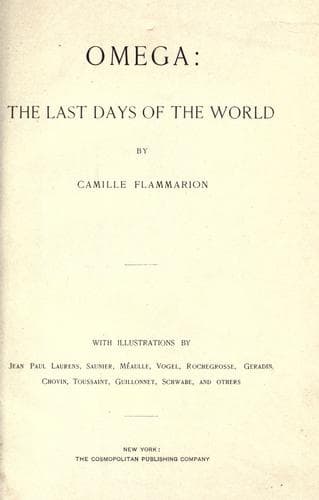
Omega: The Last days of the WorldFlammarion, Camille
Philosophy
Omega: The Last days of the World
Flammarion, Camille
End of the world -- Fiction; Science fiction
There was every indication that the end of the world was at hand.
Nothing was wanting. The Apocalypse announced it.
But a calm followed the storm. The terrible Jewish war came to an end;
Nero fell before Galba; under Vespasian and Titus, peace (71) succeeded
war, and—the end of the world was not yet.
Once more it became necessary to interpret anew the words of the
evangelists. The coming of Christ was put off until after the fall of
the Roman empire, and thus considerable margin was given to the
commentator. A firm belief in a final and even an imminent catastrophe
persisted, but it was couched in vague terms, which robbed the spirit as
well as the letter of the prophecy of all precision. Still, the
conviction remained.
St. Augustine devotes the XXth book of the City of God (426) to the
regeneration of the world, the resurrection, the last judgment, and the
New Jerusalem; in the XXIst book he describes the everlasting torments
of hell-fire. A witness to the fall of Rome and the empire, the bishop
of Carthage believed these events to be the first act of the drama. But
the reign of God was to continue a thousand years before the coming of
Satan.
St. Gregory, bishop of Tours (573), the first historian of the Franks,
began his history as follows: “As I am about to relate the wars of the
kings with hostile nations, I feel impelled to declare my belief. The
terror with which men await the end of the world decides me to chronicle
the years already passed, that thus one may know exactly how many have
elapsed since the beginning of the world.”
This tradition was perpetuated from year to year and from century to
century, notwithstanding that nature failed to confirm it. Every
catastrophe, earthquake, epidemic, famine and flood, every phenomenon,
eclipse, comet, storm, sudden darkness and tempest, was looked upon as
the forerunner and herald of the final cataclysm. Trembling like leaves
in the blast, the faithful awaited the coming judgment; and preachers
successfully worked upon this dread apprehension, so deeply rooted in
every heart.
But, as generation after generation passed, it became necessary to
define again the widespread tradition, and about this time the idea of a
millennium took form in the minds of commentators. There were many sects
which believed that Christ would reign with the saints a thousand years
before the day of judgment. St. Irenus, St. Papias, and St. Sulpicius
Severus shared this belief, which acquired an exaggerated and sensual
form in the minds of many, who looked forward to a day of general
rejoicing for the elect and a reign of pleasure. St. Jerome and St.
Augustine did much to discredit these views, but did not attack the
central doctrine of a resurrection. Commentators on the Apocalypse
continued to flourish through the somber night of the middle ages, and
in the tenth century especially the belief gained ground that the year
1000 was to usher in the great change.
Public-domain text, read in full here on John Shaqi.
Reviews
Reviews
No reviews yet
Be the first to share your thoughts on this work.
Elsewhere in the archive
Join the Discussion
Join the discussion
Sign in to leave a comment or review.
Sign InorCreate an account