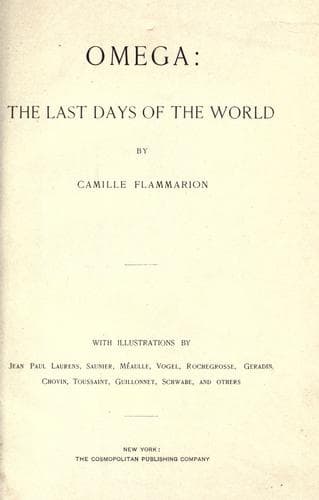
Omega: The Last days of the WorldFlammarion, Camille
Philosophy
Omega: The Last days of the World
Flammarion, Camille
End of the world -- Fiction; Science fiction
Computation had indicated that the earth would penetrate the heart of
the comet as a bullet would penetrate a cloud, and that the transit,
reckoning from the first instant of contact of the outer zones of the
comet’s atmosphere with those of the earth, would consume four and
one-half hours,—a fact easily established, inasmuch as the comet, having
a diameter about sixty-five times that of the earth, would be traversed,
not centrally, but at one-quarter of the distance from the center, with
a velocity of about 173,000 kilometers per hour. Nearly forty minutes
after the first instant of contact, the heat of this incandescent
furnace, and the horrible odor of sulphur, became so suffocating that a
few moments more of such torture would have sufficed to destroy every
vestige of life. Even the astronomers crept painfully from room to room
within the observatories which they had endeavored to close
hermetically, and sought shelter in the cellars; and the young computor,
whose acquaintance we have already made, was the last to remain on the
terrace, at Paris,—a few seconds only, but long enough to witness the
explosion of a formidable bolide, which was rushing southward with the
velocity of lightning. But strength was lacking for further
observations. One could breathe no longer. Besides the heat and the
dryness, so destructive to every vital function, there was the
carbonic-oxide which was already beginning to poison the atmosphere. The
ears were filled with a dull, roaring sound, the heart beat ever more
and more violently; and still this choking odor of sulphur! At the same
time a fiery rain fell from every quarter of the sky, a rain of shooting
stars, the immense majority of which did not reach the earth, although
many fell upon the roofs, and the fires which they kindled could be seen
in every direction. To these fires from heaven the fires of earth now
made answer, and the world was surrounded with electric flashes, as by
an army. Everyone, without thinking for an instant of flight, had
abandoned all hope, expecting every moment to be buried in the ruins of
the world, and those who still clung to each other, and whose only
consolation was that of dying together, clung closer, in a last embrace.
But the main body of the celestial army had passed, and a sort of
rarefaction, of vacuum, was produced in the atmosphere, perhaps as the
result of meteoric explosions; for suddenly the windows were shattered,
blown outwards, and the doors opened of themselves. A violent wind
arose, adding fury to the conflagration. Then the rain fell in torrents,
but reanimating at the same time the extinguished hope of life, and
waking mankind from its nightmare.
“_The XXVth Century! Death of the Pope and all the bishops! Fall of the
comet at Rome! Paper, sir?_”
Public-domain text, read in full here on John Shaqi.
Reviews
Reviews
No reviews yet
Be the first to share your thoughts on this work.
Elsewhere in the archive
Join the Discussion
Join the discussion
Sign in to leave a comment or review.
Sign InorCreate an account