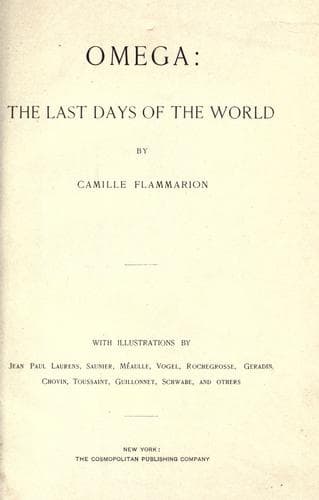
Omega: The Last days of the WorldFlammarion, Camille
Philosophy
Omega: The Last days of the World
Flammarion, Camille
End of the world -- Fiction; Science fiction
Scarcely a half hour had passed before people began to issue from their
cellars, feeling again the joy of living, and recovering gradually from
their apathy. Even before one had really begun to take any account of
the fires which were still raging, notwithstanding the deluge or rain,
the scream of the newsboy was heard in the hardly awakened streets.
Everywhere, at Paris, Marseilles, Brussels, London, Vienna, Turin and
Madrid, the same news was being shouted, and before caring for the fires
which were spreading on every side, everyone bought the popular one-cent
sheet, with its sixteen illustrated pages fresh from the press.
“_The Pope and the cardinals crushed to death! The sacred college
destroyed by the comet! Extra! Extra!_”
The newsboys drove a busy trade, for everyone was anxious to know the
truth of these announcements, and eagerly bought the great popular
socialistic paper.
[Illustration:
“EXTRA!”
]
This is what had taken place. The American Hebrew, to whom we have
already referred, and who, on the preceding Tuesday, had managed to make
several millions by the reopening of the Paris and Chicago exchanges,
had not for a moment yielded to despair, and, as in other days, the
monasteries had accepted bequests made in view of the end of the world,
so our indefatigable speculator had thought best to remain at his
telephone, which he had caused to be taken down for the nonce into a
vast subterranean gallery, hermetically closed. Controlling special
wires uniting Paris with the principal cities of the world, he was in
constant communication with them. The nucleus of the comet had contained
within its mass of incandescent gas a certain number of solid
uranolites, some of which measured several kilometers in diameter. One
of these masses had struck the earth not far from Rome, and the Roman
correspondent had sent the following news by phonogram:
“All the cardinals and prelates of the council were assembled in solemn
fête under the dome of St. Peter. In this grandest temple of
Christendom, splendidly illuminated at the solemn hour of midnight, amid
the pious invocations of the chanting brotherhoods, the altars smoking
with the perfumed incense, and the organs filling the recesses of the
immense church with their tones of thunder, the Pope, seated upon his
throne, saw prostrate at his feet his faithful people from every quarter
of the world; but as he rose to pronounce the final benediction a mass
of iron, half as large as the city itself, falling from the sky with the
rapidity of lightning, crushed the assembled multitudes, precipitating
them into an abyss of unknown depth, a veritable pit of hell. All Italy
was shaken, and the roar of the thunder was heard at Marseilles.”
Public-domain text, read in full here on John Shaqi.
Reviews
Reviews
No reviews yet
Be the first to share your thoughts on this work.
Elsewhere in the archive
Join the Discussion
Join the discussion
Sign in to leave a comment or review.
Sign InorCreate an account