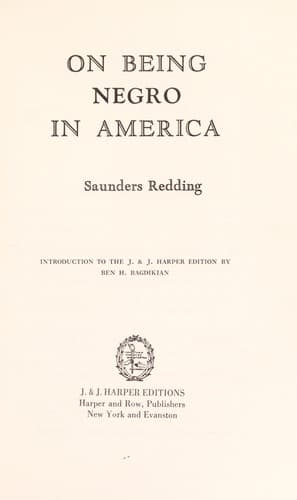
On Being Negro in AmericaRedding, J. Saunders (Jay Saunders)
General
On Being Negro in America
Redding, J. Saunders (Jay Saunders)
African Americans -- Race identity; Redding, J. Saunders (Jay Saunders), 1906-1988; United States -- Race relations
—_From notes for
“The Colonel and His Lady.”_
1
This is personal. I would call it a “document” except that the word has
overtones of something official, vested and final. But I have been
clothed with no authority to speak for others, and what I have to say
can be final only for myself. I hasten to say this at the start, for I
remember my anger at the effrontery of one who a few years ago undertook
to speak for me and twelve million others. I concurred with practically
nothing he said. This was not important in itself, but when one presumes
to speak for me he must reflect my mind so accurately that I find no
source of disagreement with him. To do this, he must be either a
lack-brain parrot or a god. Though there are many lack-brains, historic
and present circumstances prove that there are no gods dealing with the
problem of race—or, as dangerous to the American ideal and as exhausting
to individual Americans as it has been for three hundred years, it would
have been settled long ago. Else the gods are singularly perverse.
There have been opportunities for complaisant gods. Every crisis has
brought an opportunity. In Revolutionary times, even before we were a
nation and the social structure and the ways of thinking that went with
nationhood had solidified, there was splendid scope. But no gods
arrived. Again, in the awful pause following the Civil War, when the
social structure of half the country had disintegrated and men prayed
only to be told what to think and do, no god answered. Instead, the
ready devils of positive unreason took over and ruled for a long time.
The First World War and the Second held the potential too, but we common
men and the leaders we looked to were content with strong indictments
and feeble measures. There was a hell-reek of baleful prophecy:
“A small group of Negro agitators and another small group of white
rabble-rousers are pushing this country closer and closer to an
interracial explosion which may make the race riots of the First
World War and its aftermath seem mild by comparison.... Unless saner
counsels prevail we may have the worst internal clashes since
Reconstruction, with hundreds, if not thousands, killed and amicable
race relations set back for decades.”[1]
With such dire forebodings screaming in our ears, we fell back on a
peculiar (and American) misinterpretation of Hegelian philosophy—that
time, the flow of history, _inevitably_ brings changes for the better.
2
Public-domain text, read in full here on John Shaqi.
Reviews
Reviews
No reviews yet
Be the first to share your thoughts on this work.
Join the Discussion
Join the discussion
Sign in to leave a comment or review.
Sign InorCreate an account