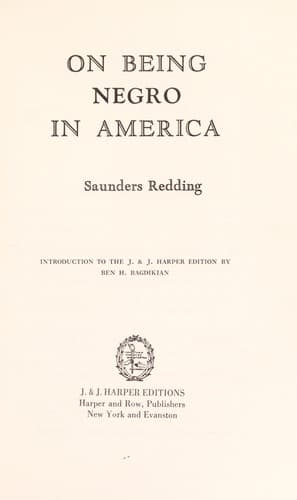
On Being Negro in AmericaRedding, J. Saunders (Jay Saunders)
General
On Being Negro in America
Redding, J. Saunders (Jay Saunders)
African Americans -- Race identity; Redding, J. Saunders (Jay Saunders), 1906-1988; United States -- Race relations
Nor could I identify myself in more than a superficial way with the
campus group of intellectual radicals with whom a common interest in
writing brought me into contact. They were enthusiastic and wellmeaning,
but quite innocent and harmless. They knew considerably more about John
Reed, Heywood Broun and H. L. Mencken than about Marx, Lenin and the
deviationism of Trotsky. They knew something about Nietzsche too, and
they were learning, goggle-eyed, something about Freud. But the German
philosopher’s “will to power” was not translated into political terms,
and Freud’s _Civilization and Its Discontents_, which had only recently
appeared in this country, was simply a yardstick by which they measured
their imaginary personal gripes against smugness and conservatism.
Theirs was the rebellion of youth. They talked a lot, but what they said
was mostly brilliant nonsense which had no more relation to the actual
destruction of the bridges over which their parents had passed than a
pyrotechnic display on a moonless night. Only one of them became a
writer—a humorist, and a good one. His latest book now lies before me.
Sensitive, talented, some of them wealthy, they turned out to be
thoroughly conservative college professors, investment brokers and
lawyers who had no trouble making a peace with things as they are.
My problems were different from theirs. The drives—self-preservation,
anxiety, vanity, sex, the “complete discharge of strength” Nietzsche
speaks of—were considerably modified by my Negroness. Such an admission
is embarrassing to make, but I recognized its truth even then.
Self-preservation, for instance, was not a galvanic drive in me, nor in
other Negroes I knew. I have written elsewhere that five of my closest
acquaintances committed suicide in a span of six red and terrible years.
Pride and vanity were excessive. Since Negroes were assumed to be
sexually immoderate, I made a show of strict asceticism, chastising the
flesh in a way most unnatural to youth. What I did not recognize was
that I was being forced into the narrowest egocentrism; into an
involvement with self that was morbid beyond reason and that only the
lucky are able to sublimate—and this only partially—into group concern
and, with extreme luck, wider social concern. It need not be said, and
certainly not in the way of apology, that this is not altogether the
fault of the Negro. It is the fault also of the American
life-situation—neither quite an accidental wickedness nor a complex of
impersonal coercions—over which both the individual and the group
control of minority people is limited.
The campus group of intellectual radicals broadened me. They stimulated
my reading, my imagination, my sympathies. To the reading of James,
Santayana and DeUnamuno, to whom Professor Ducasse had introduced me, I
added Nietzsche (especially _Thus Spake Zarathustra_) and Marx and much
else that I would not have come across in the ordinary routine of my
graduate study.
Public-domain text, read in full here on John Shaqi.
Reviews
Reviews
No reviews yet
Be the first to share your thoughts on this work.
Join the Discussion
Join the discussion
Sign in to leave a comment or review.
Sign InorCreate an account