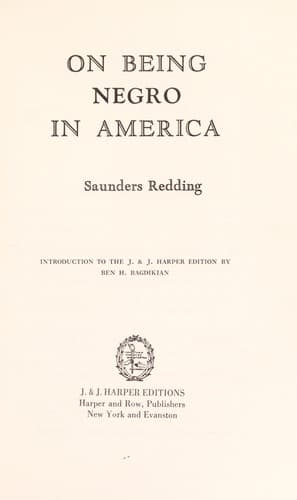
On Being Negro in AmericaRedding, J. Saunders (Jay Saunders)
General
On Being Negro in America
Redding, J. Saunders (Jay Saunders)
African Americans -- Race identity; Redding, J. Saunders (Jay Saunders), 1906-1988; United States -- Race relations
But I did not figure on the proselyting passion of Philip and Honey.
This latter was one of the five women in the cell whom I had seen
regularly at meetings. “Honey” was a cell nickname, and it suited only
her physical appearance. Among her colleagues at the city hospital,
where she told me she worked as a technician, she was known as Branca. I
never learned her last name. Of foreign extraction—Austrian or Czech, I
judged—she had soft honey-blond hair, worn in a long bob, so that when
she turned or lowered her head a wave of hair fell across her face. It
was a good face, not pretty and decorated, but well-structured and
strong, with pale yellow eyes set under square brows. She talked a great
deal in a rather strident and insolent tone, and she laughed a lot,
insolently too. Both her laughter and her talk seemed to come from very
near the surface. Yet one felt that she had depths. Sometimes one was as
hard put to follow the erratic train of her thought as to follow her
restless, vital movements.
Philip and Honey came to my lodginghouse one night after I had twice
failed to show up at meetings. It was embarrassing to have them come
there, for my landlady, though she had been born and had lived all her
life in New England and though she thought that this was in itself some
sort of victory or credit for a Negro—my landlady was only less
suspicious of white people than she was of Negroes who consorted with
them. Even had they desired it, my visitors could not have come in, so I
went with them to the two untidy rooms which Honey occupied over a
delicatessen in the oldest and a-step-from-genteel section of the city.
There were just the three of us, and over a bottle of very sour wine,
which was called dago red, they questioned me about my absences. I told
them that I had been preparing for midyear examinations, which was true,
and anyway was I to consider myself obligated to be present at every
cell meeting?
Public-domain text, read in full here on John Shaqi.
Reviews
Reviews
No reviews yet
Be the first to share your thoughts on this work.
Join the Discussion
Join the discussion
Sign in to leave a comment or review.
Sign InorCreate an account