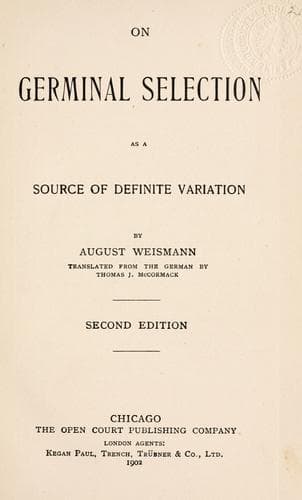
On Germinal Selection as a Source of Definite VariationWeismann, August
Science
On Germinal Selection as a Source of Definite Variation
Weismann, August
Variation (Biology)
For, in most retrogressive processes _active_ selection in Darwin's sense
plays no part, and advocates of the Lamarckian principle, as above
remarked, have rightly denied that active selection, that is, the selection
of individuals possessing the useless organ in its most reduced state, is
sufficient to explain the process of degeneration. I, for my part, have
never assumed this, {39} and I enunciated precisely on this account the
_principle of panmixia_. Now, although this, as I still have no reason for
doubting, is a perfectly correct principle, which really does have an
essential and indispensable share in the process of retrogression, still it
is not _alone_ sufficient for a full explanation of the phenomena. My
opponents, in advancing this objection, were right, to the extent indicated
and as I expressly acknowledge, although they were unable to substitute
anything positive in its stead or to render my explanation complete. The
very fact of the cessation of control over the organ is sufficient to
explain its _degeneration_, that is, its deterioration, the disharmony of
its parts, but not the fact which actually and always occurs where an organ
has become useless--viz., _its gradual and unceasing diminution continuing
for thousands and thousands of years culminating in its final and absolute
effacement._
If, now, neither the selection of persons nor the cessation of personal
selection can explain this phenomenon, assuredly some other principle must
be the efficient cause here, and this cause I believe I have indicated in
an essay written at the close of last year and only recently published.[14]
I call it _germinal selection_.
The principle in question reposes on the application, made some fifteen
years ago by Wilhelm Roux, of the principle of selection to the _parts_ of
organisms--on the _struggle of the parts_, as he called it. If such a
struggle obtains among organs, tissues, and cells, it must also obtain
between the smallest and for us invisible vital particles, not only between
those of the body-cells, strictly so called, but also between those of the
{40} germinal cells. Roux himself spoke of the struggle of the molecules,
by which he presumably understood the smallest ultimate units of vital
phenomena--elements which De Vries designated pangenes, Wiesner plasomes,
and I _biophores_, after Bruecke's ingenious conception[15] of these
invisible entities had been almost totally forgotten, or at least had lain
unnoticed for thirty years. No struggle, as that is understood in the
theory of selection, could take place between real {41} molecules, for
molecules are neither nourished, subject to growth, nor propagated.
The gradual degeneration of organs grown useless may be explained, now, by
the theory of determinants very simply and without any co-operation on the
part of active personal selection, as follows.
Public-domain text, read in full here on John Shaqi.
Reviews
Reviews
No reviews yet
Be the first to share your thoughts on this work.
Join the Discussion
Join the discussion
Sign in to leave a comment or review.
Sign InorCreate an account