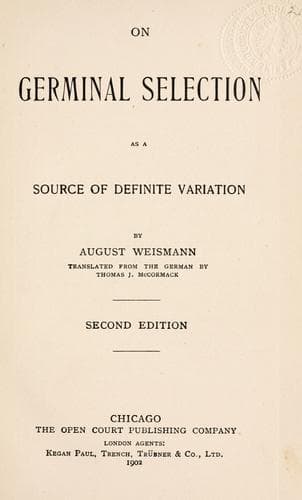
On Germinal Selection as a Source of Definite Variation — John Shaqi
On Germinal Selection as a Source of Definite VariationWeismann, August
Science
On Germinal Selection as a Source of Definite Variation
Weismann, August
Variation (Biology)
solely because the zero-point has been pushed farther upwards, but because
they themselves now oppose a relatively more powerful front to their
neighbors, that is, actively absorb more nutriment, and upon the whole
increase in vigor and produce more robust descendants. From the relative
vigor or dynamic status of the particles of the germ-plasm, thus, will
issue spontaneously an ascending line of variation, precisely as the facts
of evolution require. For, as I have already said, it is not sufficient
that the augmentation of a character should be brought about by
uninterrupted personal selection, even supposing that the displacement of
the zero-point were possible without germinal selection.
Thus, I think, may be explained how personal selection imparts the initial
impulse to processes in the germ-plasm, which, when they are once set
agoing, persist of themselves in the same direction, and are, therefore, in
no need of the continued supplementary help of personal selection, _as
directed exclusively to a definite part_. If but from time to time, that
is, if upon the average the poorest individuals, the bearers of the weakest
determinants, are eliminated, the variational direction of the part in
question, now reposing on germinal selection, must persist, and it will
very slowly but very surely increase until further development is impeded
by its inutility and personal selection {46} arrests the process, that is,
ceases to eliminate the weaker individuals.
In this manner it becomes intelligible how a large number of modifications
varying in kind and far more so in degree can be guided _simultaneously_ by
personal selection; how in strict conformity with its adaptive wants every
part is modified, or preserved unmodified; how a given articulation can
undergo modifications, causing it to disappear on one side, to grow in
volume on another, and to continue unaltered on a third. For every part
that is perfectly adapted, although it can fluctuate slightly, yet can
never undergo a permanent alteration in the ascending or descending
direction because every plus and every minus variation which has attained
selective value would be eliminated by personal selection in the course of
time. Therefore, a definite direction of variation cannot arise in such
cases and we have also reached, as it seems to me, a satisfactory
explanation of the _constancy_ of well-adapted species and characters.
Hitherto I have spoken only of plus and minus variation. But there exist,
as we know, not only variations of size but also variations of _kind_; and
the coloration of the wings of butterflies, which we chose above as our
example, would fall, according to the ordinary usage of speech, under just
this head of variations of quality. The question arises, therefore, Have
the principles just developed any claim to validity in the explanation of
_qualitative_ modifications?
Public-domain text, read in full here on John Shaqi.
Reviews
Reviews
No reviews yet
Be the first to share your thoughts on this work.
Join the Discussion
Join the discussion
Sign in to leave a comment or review.
Sign InorCreate an account