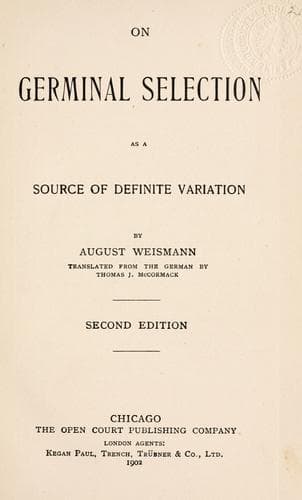
On Germinal Selection as a Source of Definite VariationWeismann, August
Science
On Germinal Selection as a Source of Definite Variation
Weismann, August
Variation (Biology)
The principal and fundamental objection that selection is unable to create
the variations with which it works, is removed by the apprehension that a
germinal selection exists. Natural selection is not compelled to wait until
"chance" presents the favorable variations, but supposing merely that the
groundwork for favorable variations is present in the transforming species,
that is, supposing merely that in the constitutional basis of the part to
be changed are contained components which render favorable variations
possible by a change of their numerical ratio, then those variations _must_
occur, for the reason that quantitative fluctuations are always happening,
and they must also be augmented as soon as personal selection intervenes
and permanently holds over them her protecting hand. Not only is the
marvelous _certainty and exactitude_ with which adaptation has operated in
so many individual cases, rendered intelligible in this manner, but what is
more difficult, we are able to understand the _simultaneity_ of numerous
and totally different modifications of the most diverse parts co-operant
towards some collective end, such as we see so frequently occur, {62} for
example, in the simultaneous rise of instincts and protective similarities,
or in the harmonious and simultaneous augmentation of two co-operant but
independent organs, as of the eye and of the centre of vision, or of the
nerve and its muscle, etc.
The "secret law," of which Wolff prophetically speaks in his criticism of
selection, is in all likelihood naught else than germinal selection. This
it is that brings it about that the necessary variations are always
present, that symmetrical parts, for example, the two eyes, usually vary
alike, but under circumstances may vary differently, for example, the two
visual halves of soles; that homodynamic parts, (for instance, the
member-pairs of Arthropoda,) have frequently varied alike, and not
infrequently and in conformity with the needs of the animal, have varied
differently. It brings it about also that conversely species of quite
different fundamental constitutions occasionally vary alike, as instances
of mimicry and numerous other cases of convergence show us. As soon as
utility itself is supposed to exercise a determinative influence on the
direction of variation, we get an insight into the entire process and into
much else besides that has hitherto been regarded as a stumbling-block to
the theory of selection, and which did indeed present difficulties that for
the moment were insuperable--as, for example, the like-directed variation
of a large number of already existing similar parts, seen in the origin of
feathers from the scales of reptiles. The utility in the last-mentioned
instance consisted, not in the transformation of one or two, but of _all_
the scales; consequently the line of variation of _all_ the scales must
have been started simultaneously in the same direction. A large part of the
Public-domain text, read in full here on John Shaqi.
Reviews
Reviews
No reviews yet
Be the first to share your thoughts on this work.
Join the Discussion
Join the discussion
Sign in to leave a comment or review.
Sign InorCreate an account