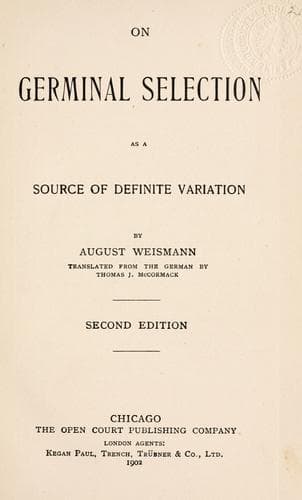
On Germinal Selection as a Source of Definite VariationWeismann, August
Science
On Germinal Selection as a Source of Definite Variation
Weismann, August
Variation (Biology)
[15] Delage, in _La structure du protoplasma et les theories sur
l'heredite_, etc., Paris, 1895, is mistaken in attributing to Herbert
Spencer the merit of having first pointed out the necessity of the
assumption of biological units ranking between the molecule and the cell.
Bruecke set forth this idea three years previously to Spencer and
established it exhaustively in a paper which in Germany at least is famous
("Elementarorganismen," _Wiener Sitzungsberichte_, October 10, 1861, Vol.
XLIV., II., p. 381). Spencer's _Principles of Biology_ appeared between
1864 and 1868; consequently there can be no dispute touching the priority
of the idea. Strangely enough Delage cites Bruecke's essay in the
Bibliographical Index at the end of his book correctly, although Bruecke's
name and views are nowhere mentioned in the book itself. It is to be
observed, however, that the elementary organisms of Bruecke are not merely
the precursors of Spencer's "physiological units," but repose on much
firmer foundations than the latter, which, as Delage himself remarks, are
at bottom nothing more than magnified molecules and not combinations of
different molecules of such character as to produce necessarily phenomena
of life. He aptly remarks on this point: "the physiological units of
Spencer are only chemical molecules of greater complexity than the rest,
and as he defines them they would be regarded as such by every chemist. He
attributes to them no property _essentially_ different from those of
chemical molecules." Assimilation, growth, propagation, in short the
attributes of life, are not attributed by Spencer to his units, while
Bruecke by his very designation "elementary organisms" expresses the idea
of "ultimate living units," to use Wiesner's phrase. Of course this
particular aspect of the vital units was not emphasised by Bruecke with the
same distinctness and sharpness as by recent inquirers, who took up
Bruecke's ideas thirty years after. I refer to the conception that the
union of a definite combination of heterogeneous molecules into an
invisibly small unit, forms the cradle or focus of the vital phenomena.
This was first done and apparently on independent considerations by De
Vries, and soon after by Wiesner, and subsequently by myself (De Vries,
_Intracellulaere Pangenesis_, Jena, 1889; Wiesner, _Die Elementarstructur
and das Wachsthum der lebenden Substanz_, Vienna, 1892; Weismann, _Das
Keimplasma_, Jena, 1892). Let me say at the close of this note that it is
not my intention in thus defending the rights of a great physiologist, to
censure in the least the distinguished author of _L'heredite_ who has set
himself a remarkably high standard of exactitude in such matters.
Certainly, when we consider the enormous extent of the literature that had
to be mastered to produce his book, embracing as it did all the various
theories of recent times, such an oversight is quite excusable.
Public-domain text, read in full here on John Shaqi.
Reviews
Reviews
No reviews yet
Be the first to share your thoughts on this work.
Join the Discussion
Join the discussion
Sign in to leave a comment or review.
Sign InorCreate an account