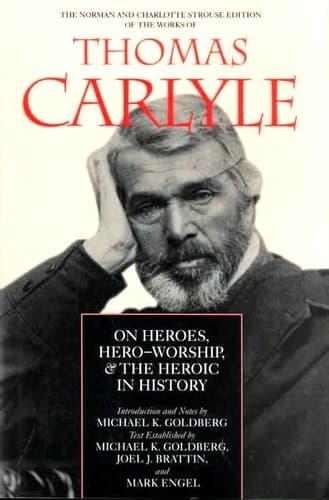
On Heroes, Hero-Worship, and the Heroic in HistoryCarlyle, Thomas
Philosophy
On Heroes, Hero-Worship, and the Heroic in History
Carlyle, Thomas
Hero worship; Heroes
This was probably the first light-point in the history of Luther, his
purer will now first decisively uttering itself; but, for the present,
it was still as one light-point in an element all of darkness. He says
he was a pious monk, _ich bin ein frommer Monch gewesen_; faithfully,
painfully struggling to work out the truth of this high act of his; but
it was to little purpose. His misery had not lessened; had rather, as it
were, increased into infinitude. The drudgeries he had to do, as novice
in his Convent, all sorts of slave-work, were not his grievance:
the deep earnest soul of the man had fallen into all manner of black
scruples, dubitations; he believed himself likely to die soon, and far
worse than die. One hears with a new interest for poor Luther that, at
this time, he lived in terror of the unspeakable misery; fancied that he
was doomed to eternal reprobation. Was it not the humble sincere nature
of the man? What was he, that he should be raised to Heaven! He that
had known only misery, and mean slavery: the news was too blessed to
be credible. It could not become clear to him how, by fasts, vigils,
formalities and mass-work, a man's soul could be saved. He fell into
the blackest wretchedness; had to wander staggering as on the verge of
bottomless Despair.
It must have been a most blessed discovery, that of an old Latin Bible
which he found in the Erfurt Library about this time. He had never seen
the Book before. It taught him another lesson than that of fasts and
vigils. A brother monk too, of pious experience, was helpful. Luther
learned now that a man was saved not by singing masses, but by the
infinite grace of God: a more credible hypothesis. He gradually got
himself founded, as on the rock. No wonder he should venerate the Bible,
which had brought this blessed help to him. He prized it as the Word of
the Highest must be prized by such a man. He determined to hold by that;
as through life and to death he firmly did.
This, then, is his deliverance from darkness, his final triumph over
darkness, what we call his conversion; for himself the most important of
all epochs. That he should now grow daily in peace and clearness; that,
unfolding now the great talents and virtues implanted in him, he should
rise to importance in his Convent, in his country, and be found more and
more useful in all honest business of life, is a natural result. He was
sent on missions by his Augustine Order, as a man of talent and fidelity
fit to do their business well: the Elector of Saxony, Friedrich, named
the Wise, a truly wise and just prince, had cast his eye on him as a
valuable person; made him Professor in his new University of Wittenberg,
Preacher too at Wittenberg; in both which capacities, as in all duties
he did, this Luther, in the peaceable sphere of common life, was gaining
more and more esteem with all good men.
Public-domain text, read in full here on John Shaqi.
Reviews
Reviews
No reviews yet
Be the first to share your thoughts on this work.
Elsewhere in the archive
Join the Discussion
Join the discussion
Sign in to leave a comment or review.
Sign InorCreate an account