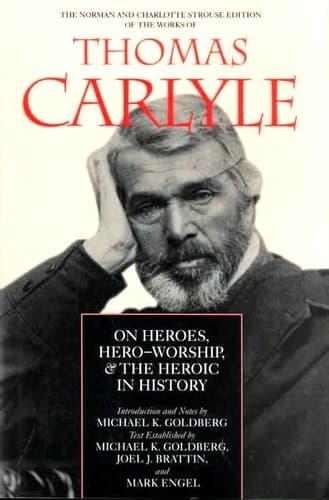
On Heroes, Hero-Worship, and the Heroic in HistoryCarlyle, Thomas
Philosophy
On Heroes, Hero-Worship, and the Heroic in History
Carlyle, Thomas
Hero worship; Heroes
It was in his twenty-seventh year that he first saw Rome; being sent
thither, as I said, on mission from his Convent. Pope Julius the Second,
and what was going on at Rome, must have filled the mind of Luther
with amazement. He had come as to the Sacred City, throne of God's
High-priest on Earth; and he found it--what we know! Many thoughts it
must have given the man; many which we have no record of, which perhaps
he did not himself know how to utter. This Rome, this scene of false
priests, clothed not in the beauty of holiness, but in far other
vesture, is _false_: but what is it to Luther? A mean man he, how shall
he reform a world? That was far from his thoughts. A humble, solitary
man, why should he at all meddle with the world? It was the task of
quite higher men than he. His business was to guide his own footsteps
wisely through the world. Let him do his own obscure duty in it well;
the rest, horrible and dismal as it looks, is in God's hand, not in his.
It is curious to reflect what might have been the issue, had Roman
Popery happened to pass this Luther by; to go on in its great wasteful
orbit, and not come athwart his little path, and force him to assault
it! Conceivable enough that, in this case, he might have held his peace
about the abuses of Rome; left Providence, and God on high, to deal with
them! A modest quiet man; not prompt he to attack irreverently persons
in authority. His clear task, as I say, was to do his own duty; to
walk wisely in this world of confused wickedness, and save his own soul
alive. But the Roman High-priesthood did come athwart him: afar off
at Wittenberg he, Luther, could not get lived in honesty for it; he
remonstrated, resisted, came to extremity; was struck at, struck again,
and so it came to wager of battle between them! This is worth attending
to in Luther's history. Perhaps no man of so humble, peaceable a
disposition ever filled the world with contention. We cannot but see
that he would have loved privacy, quiet diligence in the shade; that it
was against his will he ever became a notoriety. Notoriety: what would
that do for him? The goal of his march through this world was the
Infinite Heaven; an indubitable goal for him: in a few years, he should
either have attained that, or lost it forever! We will say nothing at
all, I think, of that sorrowfulest of theories, of its being some mean
shopkeeper grudge, of the Augustine Monk against the Dominican,
that first kindled the wrath of Luther, and produced the Protestant
Reformation. We will say to the people who maintain it, if indeed any
such exist now: Get first into the sphere of thought by which it is
so much as possible to judge of Luther, or of any man like Luther,
otherwise than distractedly; we may then begin arguing with you.
Public-domain text, read in full here on John Shaqi.
Reviews
Reviews
No reviews yet
Be the first to share your thoughts on this work.
Elsewhere in the archive
Join the Discussion
Join the discussion
Sign in to leave a comment or review.
Sign InorCreate an account