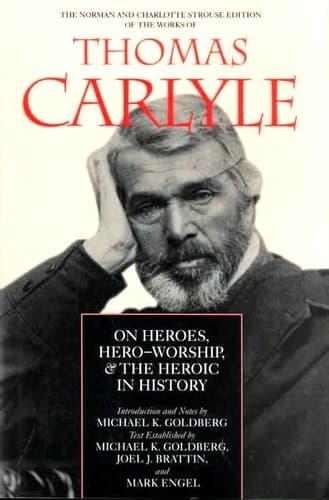
On Heroes, Hero-Worship, and the Heroic in HistoryCarlyle, Thomas
Philosophy
On Heroes, Hero-Worship, and the Heroic in History
Carlyle, Thomas
Hero worship; Heroes
Withal, unexpectedly enough, this Knox has a vein of drollery in him;
which I like much, in combination with his other qualities. He has a
true eye for the ridiculous. His _History_, with its rough earnestness,
is curiously enlivened with this. When the two Prelates, entering
Glasgow Cathedral, quarrel about precedence; march rapidly up, take
to hustling one another, twitching one another's rochets, and at last
flourishing their crosiers like quarter-staves, it is a great sight for
him every way! Not mockery, scorn, bitterness alone; though there is
enough of that too. But a true, loving, illuminating laugh mounts up
over the earnest visage; not a loud laugh; you would say, a laugh in
the _eyes_ most of all. An honest-hearted, brotherly man; brother to the
high, brother also to the low; sincere in his sympathy with both. He had
his pipe of Bourdeaux too, we find, in that old Edinburgh house of his;
a cheery social man, with faces that loved him! They go far wrong who
think this Knox was a gloomy, spasmodic, shrieking fanatic. Not at all:
he is one of the solidest of men. Practical, cautious-hopeful, patient;
a most shrewd, observing, quietly discerning man. In fact, he has very
much the type of character we assign to the Scotch at present: a certain
sardonic taciturnity is in him; insight enough; and a stouter heart than
he himself knows of. He has the power of holding his peace over many
things which do not vitally concern him,--"They? what are they?" But the
thing which does vitally concern him, that thing he will speak of; and
in a tone the whole world shall be made to hear: all the more emphatic
for his long silence.
This Prophet of the Scotch is to me no hateful man!--He had a sore fight
of an existence; wrestling with Popes and Principalities; in defeat,
contention, life-long struggle; rowing as a galley-slave, wandering as
an exile. A sore fight: but he won it. "Have you hope?" they asked him
in his last moment, when he could no longer speak. He lifted his finger,
"pointed upwards with his finger," and so died. Honor to him! His works
have not died. The letter of his work dies, as of all men's; but the
spirit of it never.
Public-domain text, read in full here on John Shaqi.
Reviews
Reviews
No reviews yet
Be the first to share your thoughts on this work.
Elsewhere in the archive
Join the Discussion
Join the discussion
Sign in to leave a comment or review.
Sign InorCreate an account