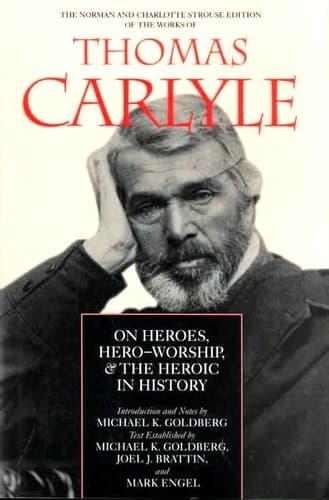
On Heroes, Hero-Worship, and the Heroic in HistoryCarlyle, Thomas
Philosophy
On Heroes, Hero-Worship, and the Heroic in History
Carlyle, Thomas
Hero worship; Heroes
One word more as to the letter of Knox's work. The unforgivable offence
in him is, that he wished to set up Priests over the head of Kings. In
other words, he strove to make the Government of Scotland a _Theocracy_.
This indeed is properly the sum of his offences, the essential sin;
for which what pardon can there be? It is most true, he did, at bottom,
consciously or unconsciously, mean a Theocracy, or Government of God. He
did mean that Kings and Prime Ministers, and all manner of persons, in
public or private, diplomatizing or whatever else they might be doing,
should walk according to the Gospel of Christ, and understand that this
was their Law, supreme over all laws. He hoped once to see such a thing
realized; and the Petition, _Thy Kingdom come_, no longer an empty word.
He was sore grieved when he saw greedy worldly Barons clutch hold of
the Church's property; when he expostulated that it was not secular
property, that it was spiritual property, and should be turned to _true_
churchly uses, education, schools, worship;--and the Regent Murray had
to answer, with a shrug of the shoulders, "It is a devout imagination!"
This was Knox's scheme of right and truth; this he zealously endeavored
after, to realize it. If we think his scheme of truth was too narrow,
was not true, we may rejoice that he could not realize it; that it
remained after two centuries of effort, unrealizable, and is a "devout
imagination" still. But how shall we blame _him_ for struggling to
realize it? Theocracy, Government of God, is precisely the thing to
be struggled for! All Prophets, zealous Priests, are there for that
purpose. Hildebrand wished a Theocracy; Cromwell wished it, fought for
it; Mahomet attained it. Nay, is it not what all zealous men, whether
called Priests, Prophets, or whatsoever else called, do essentially
wish, and must wish? That right and truth, or God's Law, reign supreme
among men, this is the Heavenly Ideal (well named in Knox's time,
and namable in all times, a revealed "Will of God") towards which the
Reformer will insist that all be more and more approximated. All true
Reformers, as I said, are by the nature of them Priests, and strive for
a Theocracy.
How far such Ideals can ever be introduced into Practice, and at what
point our impatience with their non-introduction ought to begin,
is always a question. I think we may say safely, Let them introduce
themselves as far as they can contrive to do it! If they are the true
faith of men, all men ought to be more or less impatient always where
they are not found introduced. There will never be wanting Regent
Murrays enough to shrug their shoulders, and say, "A devout
imagination!" We will praise the Hero-priest rather, who does what is in
him to bring them in; and wears out, in toil, calumny, contradiction,
a noble life, to make a God's Kingdom of this Earth. The Earth will not
become too godlike!
LECTURE V. THE HERO AS MAN OF LETTERS. JOHNSON, ROUSSEAU, BURNS.
[May 19, 1840.]
Public-domain text, read in full here on John Shaqi.
Reviews
Reviews
No reviews yet
Be the first to share your thoughts on this work.
Elsewhere in the archive
Join the Discussion
Join the discussion
Sign in to leave a comment or review.
Sign InorCreate an account