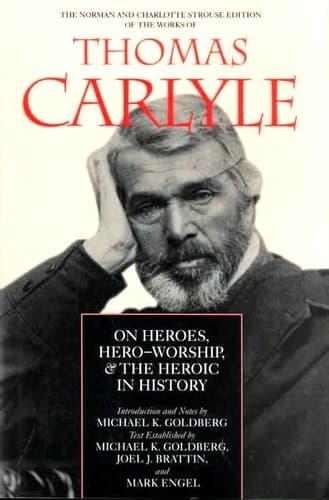
On Heroes, Hero-Worship, and the Heroic in HistoryCarlyle, Thomas
Philosophy
On Heroes, Hero-Worship, and the Heroic in History
Carlyle, Thomas
Hero worship; Heroes
Looking at the man's life with our own eyes, it seems to me, a very
different hypothesis suggests itself. What little we know of his earlier
obscure years, distorted as it has come down to us, does it not all
betoken an earnest, affectionate, sincere kind of man? His nervous
melancholic temperament indicates rather a seriousness _too_ deep for
him. Of those stories of "Spectres;" of the white Spectre in broad
daylight, predicting that he should be King of England, we are not bound
to believe much;--probably no more than of the other black Spectre,
or Devil in person, to whom the Officer _saw_ him sell himself before
Worcester Fight! But the mournful, oversensitive, hypochondriac humor
of Oliver, in his young years, is otherwise indisputably known. The
Huntingdon Physician told Sir Philip Warwick himself, He had often been
sent for at midnight; Mr. Cromwell was full of hypochondria, thought
himself near dying, and "had fancies about the Town-cross." These things
are significant. Such an excitable deep-feeling nature, in that rugged
stubborn strength of his, is not the symptom of falsehood; it is the
symptom and promise of quite other than falsehood!
The young Oliver is sent to study Law; falls, or is said to have fallen,
for a little period, into some of the dissipations of youth; but if
so, speedily repents, abandons all this: not much above twenty, he is
married, settled as an altogether grave and quiet man. "He pays back
what money he had won at gambling," says the story;--he does not think
any gain of that kind could be really _his_. It is very interesting,
very natural, this "conversion," as they well name it; this awakening of
a great true soul from the worldly slough, to see into the awful _truth_
of things;--to see that Time and its shows all rested on Eternity, and
this poor Earth of ours was the threshold either of Heaven or of Hell!
Oliver's life at St. Ives and Ely, as a sober industrious Farmer, is it
not altogether as that of a true and devout man? He has renounced the
world and its ways; _its_ prizes are not the thing that can enrich him.
He tills the earth; he reads his Bible; daily assembles his servants
round him to worship God. He comforts persecuted ministers, is fond of
preachers; nay can himself preach,--exhorts his neighbors to be wise,
to redeem the time. In all this what "hypocrisy," "ambition," "cant,"
or other falsity? The man's hopes, I do believe, were fixed on the other
Higher World; his aim to get well _thither_, by walking well through his
humble course in _this_ world. He courts no notice: what could notice
here do for him? "Ever in his great Taskmaster's eye."
Public-domain text, read in full here on John Shaqi.
Reviews
Reviews
No reviews yet
Be the first to share your thoughts on this work.
Elsewhere in the archive
Join the Discussion
Join the discussion
Sign in to leave a comment or review.
Sign InorCreate an account