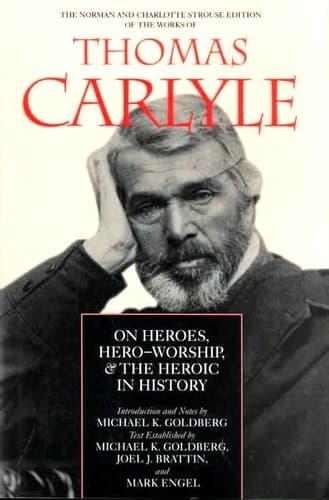
On Heroes, Hero-Worship, and the Heroic in HistoryCarlyle, Thomas
Philosophy
On Heroes, Hero-Worship, and the Heroic in History
Carlyle, Thomas
Hero worship; Heroes
Nor will his participation in the King's death involve him in
condemnation with us. It is a stern business killing of a King! But if
you once go to war with him, it lies _there_; this and all else lies
there. Once at war, you have made wager of battle with him: it is he to
die, or else you. Reconciliation is problematic; may be possible, or,
far more likely, is impossible. It is now pretty generally admitted that
the Parliament, having vanquished Charles First, had no way of making
any tenable arrangement with him. The large Presbyterian party,
apprehensive now of the Independents, were most anxious to do so;
anxious indeed as for their own existence; but it could not be. The
unhappy Charles, in those final Hampton-Court negotiations, shows
himself as a man fatally incapable of being dealt with. A man who, once
for all, could not and would not _understand_:--whose thought did not
in any measure represent to him the real fact of the matter; nay worse,
whose _word_ did not at all represent his thought. We may say this
of him without cruelty, with deep pity rather: but it is true and
undeniable. Forsaken there of all but the _name_ of Kingship, he still,
finding himself treated with outward respect as a King, fancied that
he might play off party against party, and smuggle himself into his
old power by deceiving both. Alas, they both _discovered_ that he was
deceiving them. A man whose _word_ will not inform you at all what he
means or will do, is not a man you can bargain with. You must get out
of that man's way, or put him out of yours! The Presbyterians, in
their despair, were still for believing Charles, though found false,
unbelievable again and again. Not so Cromwell: "For all our fighting,"
says he, "we are to have a little bit of paper?" No--!
In fact, everywhere we have to note the decisive practical _eye_ of this
man; how he drives towards the practical and practicable; has a genuine
insight into what _is_ fact. Such an intellect, I maintain, does not
belong to a false man: the false man sees false shows, plausibilities,
expediences: the true man is needed to discern even practical truth.
Cromwell's advice about the Parliament's Army, early in the contest, How
they were to dismiss their city-tapsters, flimsy riotous persons, and
choose substantial yeomen, whose heart was in the work, to be soldiers
for them: this is advice by a man who _saw_. Fact answers, if you see
into Fact! Cromwell's _Ironsides_ were the embodiment of this insight of
his; men fearing God; and without any other fear. No more conclusively
genuine set of fighters ever trod the soil of England, or of any other
land.
Public-domain text, read in full here on John Shaqi.
Reviews
Reviews
No reviews yet
Be the first to share your thoughts on this work.
Elsewhere in the archive
Join the Discussion
Join the discussion
Sign in to leave a comment or review.
Sign InorCreate an account