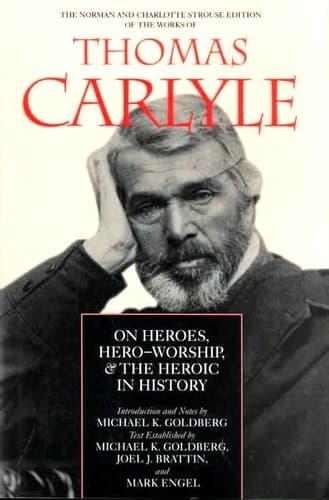
On Heroes, Hero-Worship, and the Heroic in HistoryCarlyle, Thomas
Philosophy
On Heroes, Hero-Worship, and the Heroic in History
Carlyle, Thomas
Hero worship; Heroes
But with regard to Cromwell and his purposes: Hume, and a multitude
following him, come upon me here with an admission that Cromwell _was_
sincere at first; a sincere "Fanatic" at first, but gradually became a
"Hypocrite" as things opened round him. This of the Fanatic-Hypocrite
is Hume's theory of it; extensively applied since,--to Mahomet and many
others. Think of it seriously, you will find something in it; not much,
not all, very far from all. Sincere hero hearts do not sink in this
miserable manner. The Sun flings forth impurities, gets balefully
incrusted with spots; but it does not quench itself, and become no Sun
at all, but a mass of Darkness! I will venture to say that such never
befell a great deep Cromwell; I think, never. Nature's own lionhearted
Son; Antaeus-like, his strength is got by _touching the Earth_, his
Mother; lift him up from the Earth, lift him up into Hypocrisy, Inanity,
his strength is gone. We will not assert that Cromwell was an immaculate
man; that he fell into no faults, no insincerities among the rest. He
was no dilettante professor of "perfections," "immaculate conducts."
He was a rugged Orson, rending his rough way through actual true
_work_,--_doubtless_ with many a _fall_ therein. Insincerities, faults,
very many faults daily and hourly: it was too well known to him; known
to God and him! The Sun was dimmed many a time; but the Sun had not
himself grown a Dimness. Cromwell's last words, as he lay waiting for
death, are those of a Christian heroic man. Broken prayers to God, that
He would judge him and this Cause, He since man could not, in justice
yet in pity. They are most touching words. He breathed out his wild
great soul, its toils and sins all ended now, into the presence of his
Maker, in this manner.
I, for one, will not call the man a Hypocrite! Hypocrite, mummer, the
life of him a mere theatricality; empty barren quack, hungry for the
shouts of mobs? The man had made obscurity do very well for him till his
head was gray; and now he _was_, there as he stood recognized unblamed,
the virtual King of England. Cannot a man do without King's Coaches and
Cloaks? Is it such a blessedness to have clerks forever pestering you
with bundles of papers in red tape? A simple Diocletian prefers planting
of cabbages; a George Washington, no very immeasurable man, does the
like. One would say, it is what any genuine man could do; and would do.
The instant his real work were out in the matter of Kingship,--away with
it!
Public-domain text, read in full here on John Shaqi.
Reviews
Reviews
No reviews yet
Be the first to share your thoughts on this work.
Elsewhere in the archive
Join the Discussion
Join the discussion
Sign in to leave a comment or review.
Sign InorCreate an account