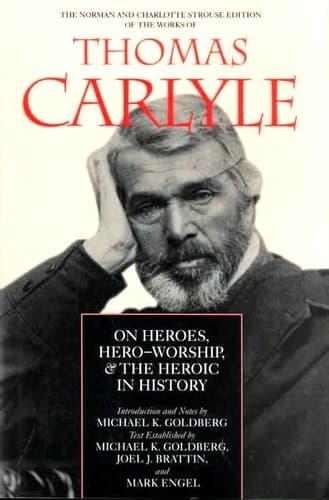
On Heroes, Hero-Worship, and the Heroic in HistoryCarlyle, Thomas
Philosophy
On Heroes, Hero-Worship, and the Heroic in History
Carlyle, Thomas
Hero worship; Heroes
Let us remark, meanwhile, how indispensable everywhere a _King_ is, in
all movements of men. It is strikingly shown, in this very War, what
becomes of men when they cannot find a Chief Man, and their enemies can.
The Scotch Nation was all but unanimous in Puritanism; zealous and of
one mind about it, as in this English end of the Island was always far
from being the case. But there was no great Cromwell among them; poor
tremulous, hesitating, diplomatic Argyles and such like: none of them
had a heart true enough for the truth, or durst commit himself to the
truth. They had no leader; and the scattered Cavalier party in that
country had one: Montrose, the noblest of all the Cavaliers; an
accomplished, gallant-hearted, splendid man; what one may call the
Hero-Cavalier. Well, look at it; on the one hand subjects without a
King; on the other a King without subjects! The subjects without King
can do nothing; the subjectless King can do something. This Montrose,
with a handful of Irish or Highland savages, few of them so much as
guns in their hands, dashes at the drilled Puritan armies like a wild
whirlwind; sweeps them, time after time, some five times over, from the
field before him. He was at one period, for a short while, master of all
Scotland. One man; but he was a man; a million zealous men, but without
the one; they against him were powerless! Perhaps of all the persons in
that Puritan struggle, from first to last, the single indispensable one
was verily Cromwell. To see and dare, and decide; to be a fixed pillar
in the welter of uncertainty;--a King among them, whether they called
him so or not.
Precisely here, however, lies the rub for Cromwell. His other
proceedings have all found advocates, and stand generally justified;
but this dismissal of the Rump Parliament and assumption of the
Protectorship, is what no one can pardon him. He had fairly grown to be
King in England; Chief Man of the victorious party in England: but it
seems he could not do without the King's Cloak, and sold himself to
perdition in order to get it. Let us see a little how this was.
Public-domain text, read in full here on John Shaqi.
Reviews
Reviews
No reviews yet
Be the first to share your thoughts on this work.
Elsewhere in the archive
Join the Discussion
Join the discussion
Sign in to leave a comment or review.
Sign InorCreate an account