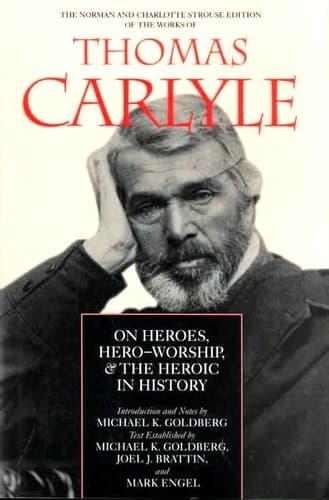
On Heroes, Hero-Worship, and the Heroic in HistoryCarlyle, Thomas
Philosophy
On Heroes, Hero-Worship, and the Heroic in History
Carlyle, Thomas
Hero worship; Heroes
to _men's_ judgment that he appealed; nor have men judged him very well.
Precisely a century and a year after this of Puritanism had got itself
hushed up into decent composure, and its results made smooth, in 1688,
there broke out a far deeper explosion, much more difficult to hush up,
known to all mortals, and like to be long known, by the name of French
Revolution. It is properly the third and final act of Protestantism; the
explosive confused return of mankind to Reality and Fact, now that they
were perishing of Semblance and Sham. We call our English Puritanism the
second act: "Well then, the Bible is true; let us go by the Bible!" "In
Church," said Luther; "In Church and State," said Cromwell, "let us go
by what actually _is_ God's Truth." Men have to return to reality; they
cannot live on semblance. The French Revolution, or third act, we may
well call the final one; for lower than that savage _Sansculottism_ men
cannot go. They stand there on the nakedest haggard Fact, undeniable in
all seasons and circumstances; and may and must begin again confidently
to build up from that. The French explosion, like the English one, got
its King,--who had no Notary parchment to show for himself. We have
still to glance for a moment at Napoleon, our second modern King.
Napoleon does by no means seem to me so great a man as Cromwell. His
enormous victories which reached over all Europe, while Cromwell abode
mainly in our little England, are but as the high _stilts_ on which the
man is seen standing; the stature of the man is not altered thereby.
I find in him no such _sincerity_ as in Cromwell; only a far inferior
sort. No silent walking, through long years, with the Awful Unnamable
of this Universe; "walking with God," as he called it; and faith and
strength in that alone: _latent_ thought and valor, content to lie
latent, then burst out as in blaze of Heaven's lightning! Napoleon lived
in an age when God was no longer believed; the meaning of all Silence,
Latency, was thought to be Nonentity: he had to begin not out of the
Puritan Bible, but out of poor Sceptical _Encyclopedies_. This was
the length the man carried it. Meritorious to get so far. His compact,
prompt, every way articulate character is in itself perhaps small,
compared with our great chaotic inarticulate Cromwell's. Instead of
"dumb Prophet struggling to speak," we have a portentous mixture of the
Quack withal! Hume's notion of the Fanatic-Hypocrite, with such truth as
it has, will apply much better to Napoleon than it did to Cromwell,
to Mahomet or the like,--where indeed taken strictly it has hardly any
truth at all. An element of blamable ambition shows itself, from the
first, in this man; gets the victory over him at last, and involves him
and his work in ruin.
Public-domain text, read in full here on John Shaqi.
Reviews
Reviews
No reviews yet
Be the first to share your thoughts on this work.
Elsewhere in the archive
Join the Discussion
Join the discussion
Sign in to leave a comment or review.
Sign InorCreate an account