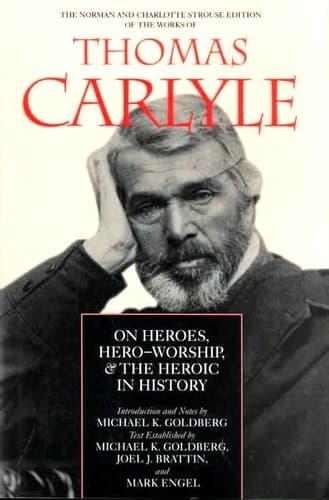
On Heroes, Hero-Worship, and the Heroic in HistoryCarlyle, Thomas
Philosophy
On Heroes, Hero-Worship, and the Heroic in History
Carlyle, Thomas
Hero worship; Heroes
"False as a bulletin" became a proverb in Napoleon's time. He makes what
excuse he could for it: that it was necessary to mislead the enemy, to
keep up his own men's courage, and so forth. On the whole, there are no
excuses. A man in no case has liberty to tell lies. It had been, in the
long-run, _better_ for Napoleon too if he had not told any. In fact,
if a man have any purpose reaching beyond the hour and day, meant to be
found extant _next_ day, what good can it ever be to promulgate lies?
The lies are found out; ruinous penalty is exacted for them. No man will
believe the liar next time even when he speaks truth, when it is of
the last importance that he be believed. The old cry of wolf!--A Lie is
no-thing; you cannot of nothing make something; you make _nothing_ at
last, and lose your labor into the bargain.
Yet Napoleon _had_ a sincerity: we are to distinguish between what is
superficial and what is fundamental in insincerity. Across these outer
manoeuverings and quackeries of his, which were many and most
blamable, let us discern withal that the man had a certain instinctive
ineradicable feeling for reality; and did base himself upon fact, so
long as he had any basis. He has an instinct of Nature better than his
culture was. His _savans_, Bourrienne tells us, in that voyage to Egypt
were one evening busily occupied arguing that there could be no God.
They had proved it, to their satisfaction, by all manner of logic.
Napoleon looking up into the stars, answers, "Very ingenious, Messieurs:
but _who made_ all that?" The Atheistic logic runs off from him like
water; the great Fact stares him in the face: "Who made all that?" So
too in Practice: he, as every man that can be great, or have victory in
this world, sees, through all entanglements, the practical heart of the
matter; drives straight towards that. When the steward of his
Tuileries Palace was exhibiting the new upholstery, with praises, and
demonstration how glorious it was, and how cheap withal, Napoleon,
making little answer, asked for a pair of scissors, clips one of the
gold tassels from a window-curtain, put it in his pocket, and walked on.
Some days afterwards, he produced it at the right moment, to the horror
of his upholstery functionary; it was not gold but tinsel! In St.
Helena, it is notable how he still, to his last days, insists on the
practical, the real. "Why talk and complain; above all, why quarrel with
one another? There is no _result_ in it; it comes to nothing that one
can _do_. Say nothing, if one can do nothing!" He speaks often so, to
his poor discontented followers; he is like a piece of silent strength
in the middle of their morbid querulousness there.
Public-domain text, read in full here on John Shaqi.
Reviews
Reviews
No reviews yet
Be the first to share your thoughts on this work.
Elsewhere in the archive
Join the Discussion
Join the discussion
Sign in to leave a comment or review.
Sign InorCreate an account