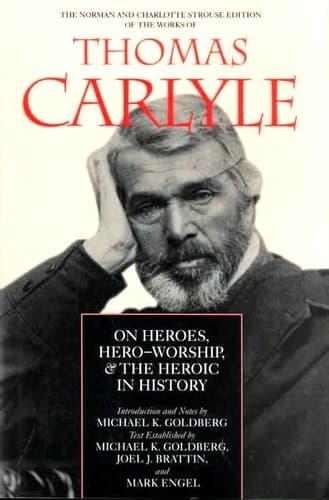
On Heroes, Hero-Worship, and the Heroic in HistoryCarlyle, Thomas
Philosophy
On Heroes, Hero-Worship, and the Heroic in History
Carlyle, Thomas
Hero worship; Heroes
And accordingly was there not what we can call a _faith_ in him, genuine
so far as it went? That this new enormous Democracy asserting itself
here in the French Revolution is an unsuppressible Fact, which the whole
world, with its old forces and institutions, cannot put down; this was
a true insight of his, and took his conscience and enthusiasm along with
it,--a _faith_. And did he not interpret the dim purport of it well?
"_La carriere ouverte aux talens_, The implements to him who can handle
them:" this actually is the truth, and even the whole truth; it includes
whatever the French Revolution or any Revolution, could mean. Napoleon,
in his first period, was a true Democrat. And yet by the nature of him,
fostered too by his military trade, he knew that Democracy, if it were
a true thing at all, could not be an anarchy: the man had a heart-hatred
for anarchy. On that Twentieth of June (1792), Bourrienne and he sat
in a coffee-house, as the mob rolled by: Napoleon expresses the deepest
contempt for persons in authority that they do not restrain this rabble.
On the Tenth of August he wonders why there is no man to command these
poor Swiss; they would conquer if there were. Such a faith in Democracy,
yet hatred of anarchy, it is that carries Napoleon through all his great
work. Through his brilliant Italian Campaigns, onwards to the Peace
of Leoben, one would say, his inspiration is: "Triumph to the French
Revolution; assertion of it against these Austrian Simulacra that
pretend to call it a Simulacrum!" Withal, however, he feels, and has a
right to feel, how necessary a strong Authority is; how the Revolution
cannot prosper or last without such. To bridle in that great devouring,
self-devouring French Revolution; to _tame_ it, so that its intrinsic
purpose can be made good, that it may become _organic_, and be able
to live among other organisms and _formed_ things, not as a wasting
destruction alone: is not this still what he partly aimed at, as the
true purport of his life; nay what he actually managed to do? Through
Wagrams, Austerlitzes; triumph after triumph,--he triumphed so far.
There was an eye to see in this man, a soul to dare and do. He rose
naturally to be the King. All men saw that he _was_ such. The common
soldiers used to say on the march: "These babbling _Avocats_, up at
Paris; all talk and no work! What wonder it runs all wrong? We shall
have to go and put our _Petit Caporal_ there!" They went, and put him
there; they and France at large. Chief-consulship, Emperorship, victory
over Europe;--till the poor Lieutenant of _La Fere_, not unnaturally,
might seem to himself the greatest of all men that had been in the world
for some ages.
Public-domain text, read in full here on John Shaqi.
Reviews
Reviews
No reviews yet
Be the first to share your thoughts on this work.
Elsewhere in the archive
Join the Discussion
Join the discussion
Sign in to leave a comment or review.
Sign InorCreate an account