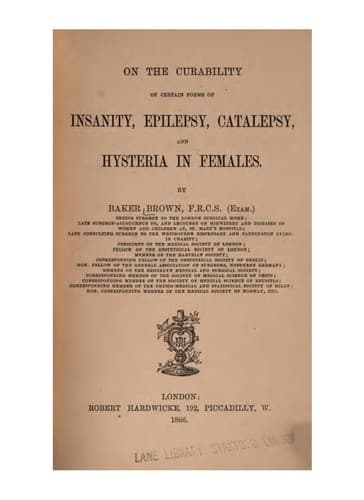
On the Curability of Certain Forms of Insanity, Epilepsy, Catalepsy, and Hysteria in Females — John Shaqi
On the Curability of Certain Forms of Insanity, Epilepsy, Catalepsy, and Hysteria in FemalesBrown, Isaac Baker
Science
On the Curability of Certain Forms of Insanity, Epilepsy, Catalepsy, and Hysteria in Females
Brown, Isaac Baker
Clitoridectomy
I have alluded in the last chapter to those patients who have no desire
to get well. Such I am not considering; and although I believe that all
the complaints of an hysterical patient are more or less exaggerated, my
experience differs from that of Dr. Handfield Jones, who believes that
such patients are not “_bonâ fide_ anxious to get well.” In his view he
is supported by Dr. Prout, who considers that “the whole energies of the
patient’s mind are bent on deception;” and by Dr. Watson, who says that
“the deceptive appearances displayed in the bodily functions and
feelings find their counterpart in the mental.” I am confident that I
have met with many instances in which the nerve power has become so
weakened that the patient, without having organic disease, really feels
all the symptoms she describes, and is only too anxious to be cured. The
cases I shall now narrate are a few of a large number that have come
under my care, and I am not without hope that their relation may show
that hysteria, instead of being a term of reproach, does truly represent
a curable disease.
The following was the first case that came under my notice, after I had
satisfied myself of the correctness of my views on the subject:—
CASE I. HYSTERIA—FIVE YEARS’ ILLNESS—OPERATION—CURE IN TWO MONTHS.
D. E., æt. 26, single; admitted into the London Surgical Home Oct. 12,
1859.
_History._—She had been a dressmaker in Yorkshire to all the best
families around, but for the last five years had been so ill as to
render her unable to do any work, and had been entirely supported by
her former customers. When in that neighbourhood, on a professional
visit to a lady, I was requested to see, amongst others, this poor
_ci-devant_ dressmaker. Her physiognomy at once told me the nature of
the case; she was much attenuated, having for a longtime been unable
to retain any food, always being sick, with great pain, immediately
after meals. She had constant acid eructations; was so weak as to be
at times unable to cross the room; complained of a burning, aching
pain, with great weakness at the lower part of the back. Her catamenia
were irregular, with much leucorrhœa; bowels generally costive. She
was very melancholy, and expressed a most earnest desire to be cured.
I advised her admission to the “Home,” and on October 15, I divided
the clitoris subcutaneously. This being my first operation, I did not
know the consequences of performing the operation in this manner. For
two days the hæmorrhage was profuse and uncontrollable. Sleep was
procured by opiates. I ordered ℥ij of olive oil to be rubbed into her
chest every night, with a view to nutrition of her attenuated frame. A
moderately generous diet was given, _but no stimulants_. She was quite
well in two months, and has never since had a day’s illness. She
resumed her occupation as a dressmaker, and recovered nearly all her
former customers.
Public-domain text, read in full here on John Shaqi.
Reviews
Reviews
No reviews yet
Be the first to share your thoughts on this work.
Join the Discussion
Join the discussion
Sign in to leave a comment or review.
Sign InorCreate an account