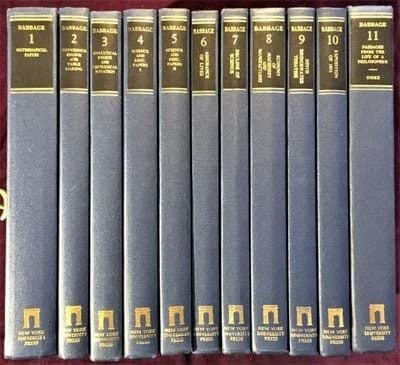
On the Economy of Machinery and ManufacturesBabbage, Charles
ReligionComparative
On the Economy of Machinery and Manufactures
Babbage, Charles
Machinery; Manufactures
7. The simple contrivance of tin tubes for speaking through,
communicating between different apartments, by which the
directions of the superintendent are instantly conveyed to the
remotest parts of an establishment, produces a considerable
economy of time. It is employed in the shops and manufactories in
London, and might with advantage be used in domestic
establishments, particularly in large houses, in conveying orders
from the nursery to the kitchen, or from the house to the stable.
Its convenience arises not merely from saving the servant or
workman useless journeys to receive directions, but from
relieving the master himself from that indisposition to give
trouble, which frequently induces him to forego a trifling want,
when he knows that his attendant must mount several flights of
stairs to ascertain his wishes, and, after descending, must mount
again to supply them. The distance to which such a mode of
communication can be extended, does not appear to have been
ascertained, and would be an interesting subject for enquiry.
Admitting it to be possible between London and Liverpool, about
seventeen minutes would elapse before the words spoken at one end
would reach the other extremity of the pipe.
8. The art of using the diamond for cutting glass has
undergone, within a few years, a very important improvement. A
glazier's apprentice, when using a diamond set in a conical
ferrule, as was always the practice about twenty years since,
found great difficulty in acquiring the art of using it with
certainty; and, at the end of a seven years' apprenticeship, many
were found but indifferently skilled in its employment. This
arose from the difficulty of finding the precise angle at which
the diamond cuts, and of guiding it along the glass at the proper
inclination when that angle is found. Almost the whole of the
time consumed and of the glass destroyed in acquiring the art of
cutting glass, may now be saved by the use of an improved tool.
The gem is set in a small piece of squared brass with its edges
nearly parallel to one side of the square. A person skilled in
its use now files away the brass on one side until, by trial, he
finds that the diamond will make a clean cut, when guided by
keeping this edge pressed against a ruler. The diamond and its
mounting are now attached to a stick like a pencil, by means of a
swivel allowing a small angular motion. Thus, even the beginner
at once applies the cutting edge at the proper angle, by pressing
the side of the brass against a ruler; and even though the part
he holds in his hand should deviate a little from the required
angle, it communicates no irregularity to the position of the
diamond, which rarely fails to do its office when thus employed.
Public-domain text, read in full here on John Shaqi.
Reviews
Reviews
No reviews yet
Be the first to share your thoughts on this work.
Join the Discussion
Join the discussion
Sign in to leave a comment or review.
Sign InorCreate an account