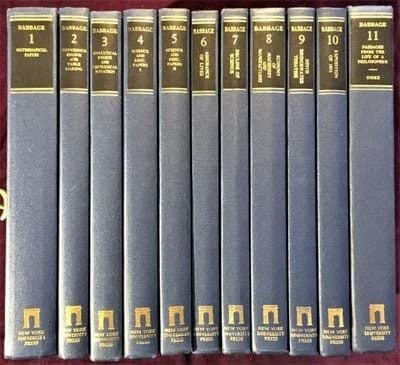
On the Economy of Machinery and ManufacturesBabbage, Charles
ReligionComparative
On the Economy of Machinery and Manufactures
Babbage, Charles
Machinery; Manufactures
221. 4. Change of tools. The employment of different tools in
the successive processes is another cause of the loss of time in
changing from one operation to another. If these tools are
simple, and the change is not frequent, the loss of time is not
considerable; but in many processes of the arts the tools are of
great delicacy, requiring accurate adjustment every time they are
used; and in many cases the time employed in adjusting bears a
large proportion to that employed in using the tool. The
sliding-rest, the dividing and the drilling-engine, are of this
kind; and hence, in manufactories of sufficient extent, it is
found to be good economy to keep one machine constantly employed
in one kind of work: one lathe, for example, having a screw
motion to its sliding-rest along the whole length of its bed, is
kept constantly making cylinders; another, having a motion for
equalizing the velocity of the work at the point at which it
passes the tool, is kept for facing surfaces; whilst a third is
constantly employed in cutting wheels.
222. 5. Skill acquired by frequent repetition of the same
processes. The constant repetition of the same process
necessarily produces in the workman a degree of excellence and
rapidity in his particular department, which is never possessed
by a person who is obliged to execute many different processes.
This rapidity is still further increased from the circumstance
that most of the operations in factories, where the division of
labour is carried to a considerable extent, are paid for as
piece-work. It is difficult to estimate in numbers the effect of
this cause upon production. In nail-making, Adam Smith has
stated, that it is almost three to one; for, he observes, that a
smith accustomed to make nails, but whose whole business has not
been that of a nailer, can make only from eight hundred to a
thousand per day; whilst a lad who had never exercised any other
trade, can make upwards of two thousand three hundred a day.
223. In different trades, the economy of production arising
from the last-mentioned cause will necessarily be different. The
case of nail-making is, perhaps, rather an extreme one. It must,
however, be observed, that, in one sense, this is not a permanent
source of advantage; for, though it acts at the commencement of
an establishment, yet every month adds to the skill of the
workmen; and at the end of three or four years they will not be
very far behind those who have never practised any other branch
of their art. Upon an occasion when a large issue of bank-notes
was required, a clerk at the Bank of England signed his name,
consisting of seven letters, including the initial of his
Christian name, five thousand three hundred times during eleven
working hours, besides arranging the notes he had signed in
parcels of fifty each.
Public-domain text, read in full here on John Shaqi.
Reviews
Reviews
No reviews yet
Be the first to share your thoughts on this work.
Elsewhere in the archive
Join the Discussion
Join the discussion
Sign in to leave a comment or review.
Sign InorCreate an account