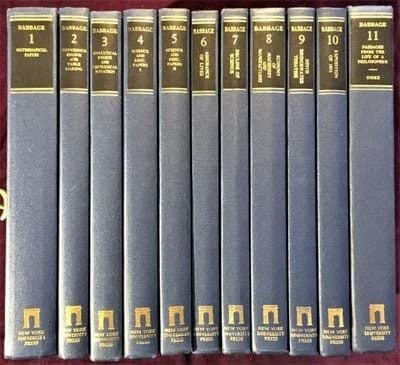
On the Economy of Machinery and ManufacturesBabbage, Charles
ReligionComparative
On the Economy of Machinery and Manufactures
Babbage, Charles
Machinery; Manufactures
1. Wire -- -- -- 24.75
2. Straightening and cutting 1.2 .5 4.5 --
3. Coarse pointing 1.2 .625 10.0 --
Turning wheel(2*) 1.2 .875 7.0 --
Fine Pointing .8 .5 9.375 --
Turning wheel 1.2 .5 4.75 --
Cutting off pointed ends .6 .375 7.5 --
4. Turning spiral .5 .125 3.0 --
Cutting off heads .8 .375 5.625 --
Fuel to anneal ditto -- -- -- .125
5. Heading 12.0 .333 4.25 --
6. Tartar for cleaning -- -- -- .5
Tartar for whitening -- -- -- .5
7. Papering 4.8 .5 2.0 --
Paper -- -- -- 1.0
Wear of tools -- -- -- 2.0
24.3 4.708
The great expense of turning the wheel appears to have arisen
from the person so occupied being unemployed during half his
time, whilst the pointer went to another manufactory
338. It appears from the analysis we have given of the art of
pinmaking, that it occupies rather more than seven hours and a
half of time, for ten different individuals working in succession
on the same material, to convert it into a pound of pins; and
that the total expense of their labour, each being paid in the
joint ratio of his skill and of the time he is employed, amounts
very nearly to 1s. 1d. But from an examination of the first of
these tables, it appears that the wages earned by the persons
employed vary from 4 1/2d. per day up to 6s., and consequently
the skill which is required for their respective employments may
be measured by those sums. Now it is evident, that if one person
were required to make the whole pound of pins, he must have skill
enough to earn about 5s. 3d. per day, whilst he is pointing the
wires or cutting off the heads from the spiral coils--and 6s.
when he is whitening the pins; which three operations together
would occupy little more than the seventeenth part of his time.
It is also apparent, that during more than one half of his time
he must be earning only 1s. 3d, per day, in putting on the heads;
although his skill, if properly employed, would, in the same
time, produce nearly five times as much. If, therefore, we were
to employ, for all the processes, the man who whitens the pins,
and who earns 6s. per day, even supposing that he could make the
pound of pins in an equally short time, yet we must pay him for
his time 46. 14 pence, or about 3s. 10d. The pins would therefore
cost, in making, three times and three quarters as much as they
now do by the application of the division of labour.
Public-domain text, read in full here on John Shaqi.
Reviews
Reviews
No reviews yet
Be the first to share your thoughts on this work.
Elsewhere in the archive
Join the Discussion
Join the discussion
Sign in to leave a comment or review.
Sign InorCreate an account