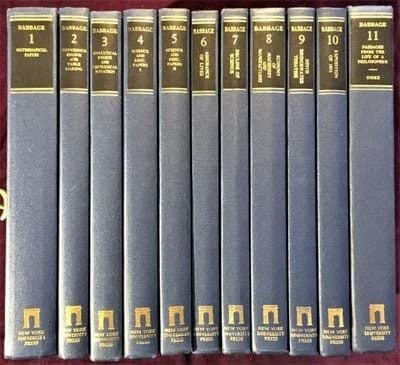
On the Economy of Machinery and ManufacturesBabbage, Charles
ReligionComparative
On the Economy of Machinery and Manufactures
Babbage, Charles
Machinery; Manufactures
The higher the skill required of the workman in any one
process of a manufacture, and the smaller the time during which
it is employed, so much the greater will be the advantage of
separating that process from the rest, and devoting one person's
attention entirely to it. Had we selected the art of
needle-making as our illustration, the economy arising from the
division of labour would have been still more striking; for the
process of tempering the needles requires great skill, attention,
and experience, and although from three to four thousand are
tempered at once, the workman is paid a very high rate of wages.
In another process of the same manufacture, dry-pointing, which
also is executed with great rapidity, the wages earned by the
workman reach from 7s. to 12s., 15s., and even, in some
instances, to 20s. per day; whilst other processes are carried on
by children paid at the rate of 6d. per day.
239. Some further reflections suggested by the preceding
analysis, will be reserved until we have placed before the reader
a brief description of a machine for making pins, invented by an
American. It is highly ingenious in point of contrivance, and, in
respect to its economical principles, will furnish a strong and
interesting contrast with the manufacture of pins by the human
hand. In this machine a coil of brass wire is placed on an axis;
one end of this wire is drawn by a pair of rollers through a
small hole in a plate of steel, and is held there by a forceps.
As soon as the machine is put in action, -
1. The forceps draws the wire on to a distance equal in
length to one pin: a cutting edge of steel then descends close to
the hole through which the wire entered, and severs the piece
drawn out.
2. The forceps holding the piece thus separated moves on,
till it brings the wire to the centre of the chuck of a small
lathe, which opens to receive it. Whilst the forceps is returning
to fetch another piece of wire, the lathe revolves rapidly, and
grinds the projecting end of the wire upon a steel mill, which
advances towards it.
3. After this first or coarse pointing, the lathe stops, and
another forceps takes hold of the half-pointed pin, (which is
instantly released by the opening of the chuck), and conveys it
to a similar chuck of an adjacent lathe, which receives it, and
finishes the pointing on a finer steel mill.
4. This mill again stops, and another forceps removes the
pointed pin into a pair of strong steel clams, having a small
groove in them by which they hold the pin very firmly. A part of
this groove, which terminates at that edge of the steel clams
which is intended to form the head of the pin, is made conical. A
small round steel punch is now driven forcibly against the end of
the wire thus clamped, and the head of the pin is partially
formed by compressing the wire into the conical cavity.
NOTES:
Public-domain text, read in full here on John Shaqi.
Reviews
Reviews
No reviews yet
Be the first to share your thoughts on this work.
Elsewhere in the archive
Join the Discussion
Join the discussion
Sign in to leave a comment or review.
Sign InorCreate an account