On the Economy of Machinery and ManufacturesBabbage, Charles
ReligionComparative
On the Economy of Machinery and Manufactures
Babbage, Charles
Machinery; Manufactures
Second section. This section consisted of seven or eight
persons of considerable acquaintance with mathematics: and their
duty was to convert into numbers the formulae put into their
hands by the first section an operation of great labour; and then
to deliver out these formulae to the members of the third
section, and receive from them the finished calculations. The
members of this second section had certain means of verifying the
calculations without the necessity of repeating, or even of
examining, the whole of the work done by the third section.
Third section. The members of this section, whose number
varied from sixty to eighty, received certain numbers from the
second section, and, using nothing more than simple addition and
subtraction, they returned to that section the tables in a
finished state. It is remarkable that nine-tenths of this class
had no knowledge of arithmetic beyond the two first rules which
they were thus called upon to exercise, and that these persons
were usually found more correct in their calculations, than those
who possessed a more extensive knowledge of the subject.
245. When it is stated that the tables thus computed occupy
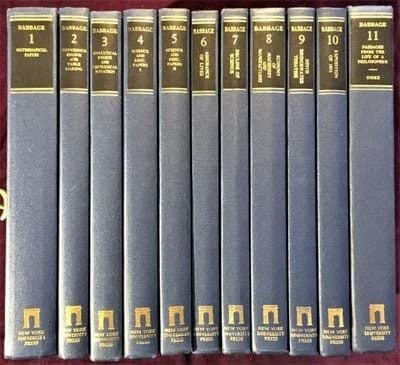
seventeen large folio volumes, some idea may perhaps be formed of
the labour. From that part executed by the third class, which may
almost be termed mechanical, requiring the least knowledge and by
far the greatest exertions, the first class were entirely exempt.
Such labour can always be purchased at an easy rate. The duties
of the second class, although requiring considerable skill in
arithmetical operations, were yet in some measure relieved by the
higher interest naturally felt in those more difficult
operations. The exertions of the first class are not likely to
require, upon another occasion, so much skill and labour as they
did upon the first attempt to introduce such a method; but when
the completion of a calculating engine shall have produced a
substitute for the whole of the third section of computers, the
attention of analysts will naturally be directed to simplifying
its application, by a new discussion of the methods of converting
analytical formulae into numbers.
Public-domain text, read in full here on John Shaqi.
Reviews
Reviews
No reviews yet
Be the first to share your thoughts on this work.
Elsewhere in the archive
Join the Discussion
Join the discussion
Sign in to leave a comment or review.
Sign InorCreate an account