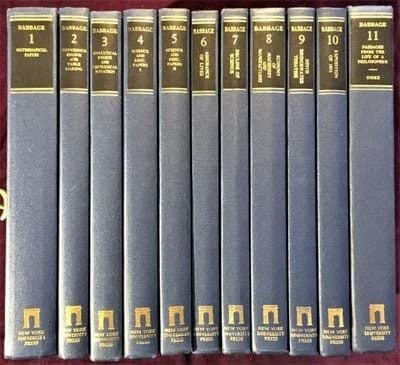
On the Economy of Machinery and ManufacturesBabbage, Charles
ReligionComparative
On the Economy of Machinery and Manufactures
Babbage, Charles
Machinery; Manufactures
277. It is found in every country, that the situation of
large manufacturing establishments is confined to particular
districts. In the earlier history of a manufacturing community,
before cheap modes of transport have been extensively introduced,
it will almost always be found that manufactories are placed near
those spots in which nature has produced the raw material:
especially in the case of articles of great weight, and in those
the value of which depends more upon the material than upon the
labour expended on it. Most of the metallic ores being
exceedingly heavy, and being mixed up with large quantities of
weighty and useless materials, must be smelted at no great
distance from the spot which affords them: fuel and power are the
requisites for reducing them; and any considerable fall of water
in the vicinity will naturally be resorted to for aid in the
coarser exertions of physical force; for pounding the ore, for
blowing the furnaces, or for hammering and rolling out the iron.
There are indeed peculiar circumstances which will modify this.
Iron, coal, and limestone, commonly occur in the same tracts; but
the union of the fuel in the same locality with the ore does not
exist with respect to other metals. The tracts generally the most
productive of metallic ores are, geologically speaking, different
from those affording coal: thus in Cornwall there are veins of
copper and of tin, but no beds of coal. The copper ore, which
requires a very large quantity of fuel for its reduction, is sent
by sea to the coalfields of Wales, and is smelted at Swansea;
whilst the vessels which convey it, take back coals to work the
steam-engines for draining the mines, and to smelt the tin, which
requires for that purpose a much smaller quantity of fuel than
copper.
Public-domain text, read in full here on John Shaqi.
Reviews
Reviews
No reviews yet
Be the first to share your thoughts on this work.
Elsewhere in the archive
Join the Discussion
Join the discussion
Sign in to leave a comment or review.
Sign InorCreate an account