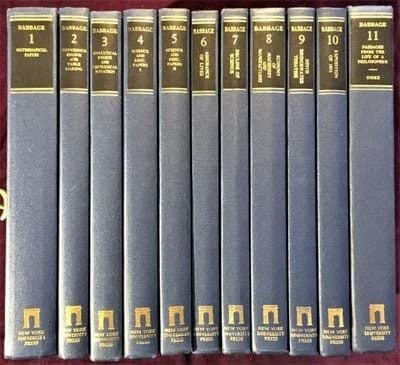
On the Economy of Machinery and ManufacturesBabbage, Charles
ReligionComparative
On the Economy of Machinery and Manufactures
Babbage, Charles
Machinery; Manufactures
322. The causes of failure in this stage most frequently
derive their origin from errors in the preceding one; and it is
sufficient merely to indicate a few of their sources. They
frequently arise from having neglected to take into consideration
that metals are not perfectly rigid but elastic. A steel cylinder
of small diameter must not be regarded as an inflexible rod; but
in order to ensure its perfect action as an axis, it must be
supported at proper intervals.
Again, the strength and stiffness of the framing which
supports the mechanism must be carefully attended to. It should
always be recollected, that the addition of superfluous matter to
the immovable parts of a machine produces no additional momentum,
and therefore is not accompanied with the same evil that arises
when the moving parts are increased in weight. The stiffness of
the framing in a machine produces an important advantage. If the
bearings of the axis (those places at which they are supported)
are once placed in a straight line, they will remain so, if the
framing be immovable; whereas if the framework changes its form,
though ever so slightly, considerable friction is immediately
produced. This effect is so well understood in the districts
where spinning factories are numerous, that, in estimating the
expense of working a new factory, it is allowed that five per
cent on the power of the steam-engine will be saved if the
building is fireproof: for the greater strength and rigidity of a
fireproof building prevents the movement of the long shafts or
axes which drive the machinery, from being impeded by the
friction that would arise from the slightest deviation in any of
the bearings.
323. In conducting experiments upon machinery, it is quite a
mistake to suppose that any imperfect mechanical work is good
enough for such a purpose. If the experiment is worth making, it
ought to be tried with all the advantages of which the state of
mechanical art admits; for an imperfect trial may cause an idea
to be given up, which better workmanship might have proved to be
practicable. On the other hand, when once the efficiency of a
contrivance has been established, with good workmanship it will
be easy afterwards to ascertain the degree of perfection which
will suffice for its due action.
Public-domain text, read in full here on John Shaqi.
Reviews
Reviews
No reviews yet
Be the first to share your thoughts on this work.
Elsewhere in the archive
Join the Discussion
Join the discussion
Sign in to leave a comment or review.
Sign InorCreate an account