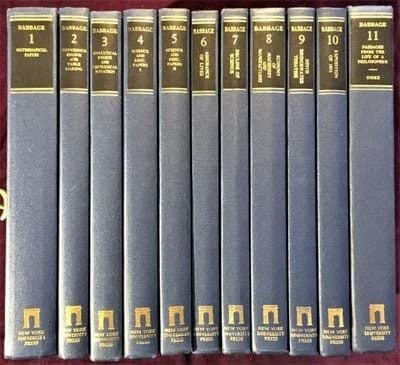
On the Economy of Machinery and ManufacturesBabbage, Charles
ReligionComparative
On the Economy of Machinery and Manufactures
Babbage, Charles
Machinery; Manufactures
324. It is partly owing to the imperfection of the original
trials, and partly to the gradual improvements in the art of
making machinery, that many inventions which have been tried, and
given up in one state of art, have at another period been
eminently successful. The idea of printing by means of moveable
types had probably suggested itself to the imagination of many
persons conversant with impressions taken either from blocks or
seals. We find amongst the instruments discovered in the remains
of Pompeii and Herculaneum, stamps for words formed out of one
piece of metal, and including several letters. The idea of
separating these letters, and of recombining them into other
words, for the purpose of stamping a book, could scarcely have
failed to occur to many: but it would almost certainly have been
rejected by those best acquainted with the mechanical arts of
that time; for the workmen of those days must have instantly
perceived the impossibility of producing many thousand pieces of
wood or metal, fitting so perfectly and ranging so uniformly, as
the types or blocks of wood now used in the art of printing.
The principle of the press which bears the name of Bramah,
was known about a century and a half before the machine, to which
it gave rise, existed; but the imperfect state of mechanical art
in the time of the discoverer, would have effectually deterred
him, if the application of it had occurred to his mind, from
attempting to employ it in practice as an instrument for exerting
force.
These considerations prove the propriety of repeating, at the
termination of intervals during which the art of making machinery
has received any great improvement, the trails of methods which,
although founded upon just principles, had previously failed.
325. When the drawings of a machine have been properly made,
and the parts have been well executed, and even when the work it
produces possesses all the qualities which were anticipated,
still the invention may fail; that is, it may fail of being
brought into general practice. This will most frequently arise
from the circumstance of its producing its work at a greater
expense than that at which it can be made by other methods.
Public-domain text, read in full here on John Shaqi.
Reviews
Reviews
No reviews yet
Be the first to share your thoughts on this work.
Elsewhere in the archive
Join the Discussion
Join the discussion
Sign in to leave a comment or review.
Sign InorCreate an account