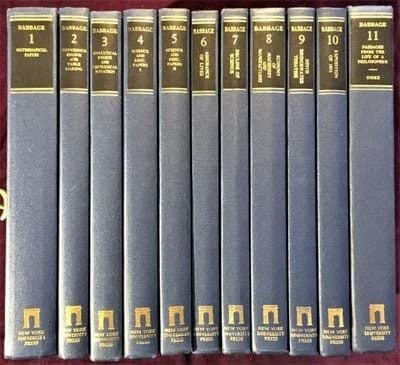
On the Economy of Machinery and ManufacturesBabbage, Charles
ReligionComparative
On the Economy of Machinery and Manufactures
Babbage, Charles
Machinery; Manufactures
"I beg to say a few words respecting the frame rent; the rent
paid for lace frames, until the year 1805, was 1s. 6d. a frame
per week; there then was not any very great inducement for
persons to buy frames and let them out by the hire, who did not
belong to the trade; at that time an attempt was made, by one or
two houses, to reduce the prices paid to the workmen, in
consequence of a dispute between these two houses and another
great house: some little difference being paid in the price
amongst the respective houses, I was one chosen by the workmen to
try if we could not remedy the impending evil: we consulted the
respective parties, and found them inflexible; these two houses
that were about to reduce the prices, said that they would either
immediately reduce the price of making net, or they would
increase the frame rent: the difference to the workmen was
considerable, between the one and the other; they would suffer
less, in the immediate operation of the thing, by having the rent
advanced, than the price of making net reduced. They chose at
that time, as they thought, the lesser evil, but it has turned
out to be otherwise; for, immediately as the rent was raised upon
the percentage laid out in frames, it induced almost every
person, who had got a little money, to lay it out in the purchase
of frames; these frames were placed in the hands of men who could
get work for them at the warehouses; they were generally
constrained to pay an enormous rent, and then they were
compelled, most likely, to buy of the persons that let them the
frames, their butcher's meat, their grocery, or their clothing:
the encumbrance of these frames became entailed upon them: if any
deadness took place in the work they must take it at a very
reduced price, for fear of the consequences that would fall upon
them from the person who bought the frame: thus the evil has been
daily increasing, till, in conjunction with the other evils crept
into the trade, they have almost crushed it to atoms."
348. The evil of not assigning fairly to each tool, or each
article produced, its proportionate value, or even of not having
a perfectly distinct, simple, and definite agreement between a
master and his workmen, is very considerable. Workmen find it
difficult in such cases to know the probable produce of their
labour; and both parties are often led to adopt arrangements,
which, had they been well examined, would have been rejected as
equally at variance in the results with the true interests of
both.
Public-domain text, read in full here on John Shaqi.
Reviews
Reviews
No reviews yet
Be the first to share your thoughts on this work.
Elsewhere in the archive
Join the Discussion
Join the discussion
Sign in to leave a comment or review.
Sign InorCreate an account