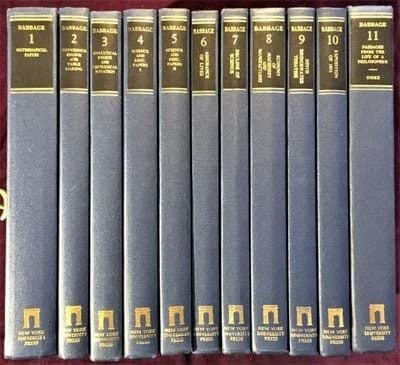
On the Economy of Machinery and ManufacturesBabbage, Charles
ReligionComparative
On the Economy of Machinery and Manufactures
Babbage, Charles
Machinery; Manufactures
349. At Birmingham, stamps and dies, and presses for a great
variety of articles, are let out: they are generally made by men
possessing small capital, and are rented by workmen. Power also
is rented at the same place. Steam-engines are erected in large
buildings containing a variety of rooms, in which each person may
hire one, two, or any other amount of horsepower, as his
occupation may require. If any mode could be discovered of
transmitting power, without much loss from friction, to
considerable distances, and at the same time of registering the
quantity made use of at any particular point, a considerable
change would probably take place in many departments of the
present system of manufacturing. A few central engines to produce
power, might then be erected in our great towns, and each
workman, hiring a quantity of power sufficient for his purpose,
might have it conveyed into his own house; and thus a transition
might in some instances be effected, if it should be found more
profitable, back again from the system of great factories to that
of domestic manufacture.
350. The transmission of water through a series of pipes,
might be employed for the distribution of power, but the friction
would consume a considerable portion. Another method has been
employed in some instances, and is practised at the Mint. It
consists in exhausting the air from a large vessel by means of a
steam-engine. This vessel is connected by pipes, with a small
piston which drives each coining press; and, on opening a valve,
the pressure of the external air forces in the piston. This air
is then admitted to the general reservoir, and pumped out by the
engine. The condensation of air might be employed for the same
purpose; but there are some unexplained facts relating to elastic
fluids, which require further observations and experiment before
they can be used for the conveyance of power to any considerable
distance. It has been found, for instance, in attempting to blow
a furnace by means of a powerful water-wheel driving air through
a cast-iron pipe of above a mile in length, that scarcely any
sensible effect was produced at the opposite extremity. In one
instance, some accidental obstruction being suspected, a cat put
in at one end found its way out without injury at the other, thus
proving that the phenomenon did not depend on interruption within
the pipe.
Public-domain text, read in full here on John Shaqi.
Reviews
Reviews
No reviews yet
Be the first to share your thoughts on this work.
Elsewhere in the archive
Join the Discussion
Join the discussion
Sign in to leave a comment or review.
Sign InorCreate an account