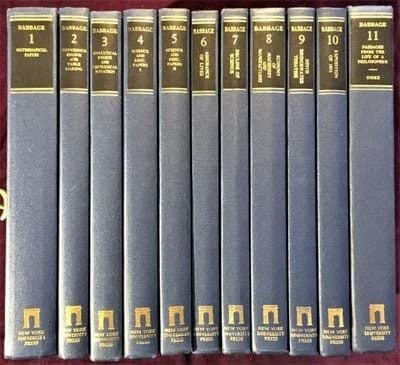
On the Economy of Machinery and ManufacturesBabbage, Charles
ReligionComparative
On the Economy of Machinery and Manufactures
Babbage, Charles
Machinery; Manufactures
361. The effects arising from combinations amongst the
workmen, are almost always injurious to the parties themselves.
There are numerous instances, in which the public suffer by
increased price at the moment, but are ultimately gainers from
the permanent reduction which results; whilst, on the other hand,
the improvements which are often made in machinery in consequence
of 'a strike' amongst the workmen, most frequently do injury, of
greater or less duration, to that particular class which gave
rise to them. As the injury to the men and to their families is
almost always more serious than that which affects their
employers, it is of the utmost importance to the comfort and
happiness of the former class, that they should themselves
entertain sound views upon this question. For this purpose a few
illustrations of the principle which is here maintained, will
probably have greater weight than any reasoning of a more general
nature, though drawn from admitted principles of political
economy. Such instances will, moreover, present the advantage of
appealing to facts known to many individuals of those classes for
whose benefit these reflections are intended.
362. There is a process in the manufacture of gun barrels for
making what, in the language of the trade, are called skelps. The
skelp is a piece or bar of iron, about three feet long, and four
inches wide, but thicker and broader at one end than at the
other; and the barrel of a musket is formed by forging out such
pieces to the proper dimensions, and then folding or bending them
into a cylindrical form, until the edges overlap, so that they
can be welded together.
About twenty years ago, the workmen, employed at a very
extensive factory in forging these skelps out of bar-iron,
'struck' for an advance of wages; and as their demands were very
exorbitant, they were not immediately complied with. In the
meantime, the superintendent of the establishment directed his
attention to the subject; and it occurred to him, that if the
circumference of the rollers, between which the bar-iron was
rolled, were to be made equal to the length of a skelp, or of a
musket barrel, and if also the groove in which the iron was
compressed, instead of being of the same width and depth
throughout, were cut gradually deeper and wider from a point on
the rollers, until it returned to the same point, then the
bar-iron passing between such rollers, instead of being uniform
in width and thickness, would have the form of a skelp. On making
the trial, it was found to succeed perfectly; a great reduction
of human labour was effected by the process, and the workmen who
had acquired peculiar skill in performing it ceased to derive any
advantage from their dexterity.
Public-domain text, read in full here on John Shaqi.
Reviews
Reviews
No reviews yet
Be the first to share your thoughts on this work.
Elsewhere in the archive
Join the Discussion
Join the discussion
Sign in to leave a comment or review.
Sign InorCreate an account