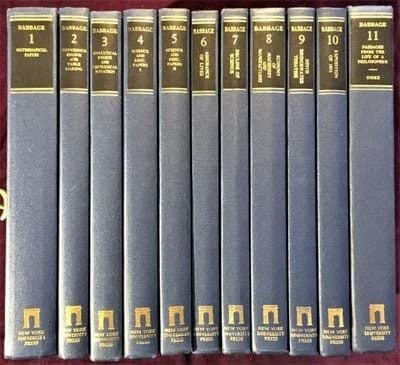
On the Economy of Machinery and ManufacturesBabbage, Charles
ReligionComparative
On the Economy of Machinery and Manufactures
Babbage, Charles
Machinery; Manufactures
359. Societies exist amongst some of the larger bodies of
workmen, and others have been formed by the masters engaged in
the same branches of trade. These associations have different
objects in view; but it is very desirable that their effects
should be well understood by the individuals who compose them;
and that the advantages arising from them, which are certainly
great, should be separated as much as possible from the evils
which they have, unfortunately, too frequently introduced.
Associations of workmen and of masters may, with advantage, agree
upon rules to be observed by both parties, in estimating the
proportionate value of different kinds of work executed in their
trade, in order that time may be saved, and disputes be
prevented. They may also be most usefully employed in acquiring
accurate information as to the number of persons working in the
various departments of any manufacture, their rate of wages, the
number of machines in use, and other statistical details.
Information of this nature is highly valuable, both for the
guidance of the parties who are themselves most interested, and
to enable them, upon any application to government for
assistance, or with a view to legislative enactments, to supply
those details, without which the propriety of any proposed
measure cannot be duly estimated. Such details may be collected
by men actually engaged in any branch of trade, at a much smaller
expense of time, than by persons less acquainted with, and less
interested in it.
360. One of the most legitimate and most important objects of
such associations as we have just mentioned, is to agree upon
ready and certain modes of measuring the quantity of work done by
the workmen. For a long time a difficulty upon this point existed
in the lace trade, which was justly complained of by the men as a
serious grievance; but the introduction of the rack, which counts
the number of holes in the length of the piece, has entirely put
an end to the most fertile cause of disputes. This invention was
adverted to by the Committee of 1812, and a hope was expressed,
in their report, that the same contrivance would be applied to
stocking-frames. It would, indeed, be of great mutual advantage
to the industrious workman, and to the master manufacturer in
every trade, if the machines employed in it could register the
quantity of work which they perform, in the same manner as a
steam-engine does the number of strokes it makes. The
introduction of such contrivances gives a greater stimulus to
honest industry than can readily be imagined, and removes one of
the sources of disagreement between parties, whose real interests
must always suffer by any estrangement between them.
Public-domain text, read in full here on John Shaqi.
Reviews
Reviews
No reviews yet
Be the first to share your thoughts on this work.
Elsewhere in the archive
Join the Discussion
Join the discussion
Sign in to leave a comment or review.
Sign InorCreate an account