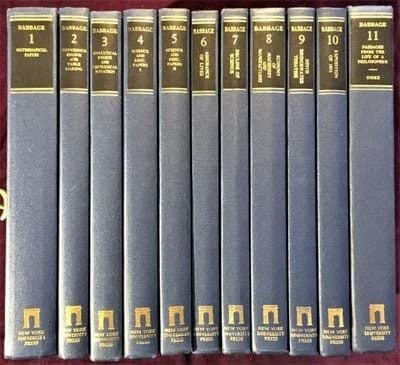
On the Economy of Machinery and ManufacturesBabbage, Charles
ReligionComparative
On the Economy of Machinery and Manufactures
Babbage, Charles
Machinery; Manufactures
found in the shops of all our larger ironmongers, of various
lengths and diameters, with screws cut at each end; and are in
constant use for the conveyance of gas for lighting, or of water
for warming, our houses.
364. Similar examples must have presented themselves to all
those who are familiar with the details of our
manufactories, but these are sufficient to illustrate one of
the results of combinations. It would not, however, be fair
to push the conclusion deduced from these instances to its
extreme limit. Although it is very apparent, that in the two
cases which have been stated, the effects of combination
were permanently injurious to the workman, by almost
immediately placing him in a lower class (with respect to
his wages) than he occupied before; yet they do not prove
that all such combinations have this effect. It is quite
evident that they have all this tendency, it is also certain
that considerable stimulus must be applied to induce a man
to contrive a new and expensive process; and that in both
these cases, unless the fear of pecuniary loss had acted
powerfully, the improvement would not have been made. If,
therefore, the workmen had in either case combined for only
a small advance of wages, they would, in all probability,
have been successful, and the public would have been
deprived, for many years, of the inventions to which these
combinations gave rise. It must, however, be observed, that
the same skill which enabled the men to obtain, after long
practice, higher wages than the rest of their class, would
prevent many of them from being permanently thrown back into
the class of ordinary workmen. Their diminished wages will
continue only until they have acquired, by practice, a
facility of execution in some other of the more difficult
operations: but a diminution of wages, even for a year or
two, is still a very serious inconvenience to any person who
lives by his daily exertion. The consequence of combination
has then, in these instances, been, to the workmen who
combined--reduction of wages; to the public -reduction of
price; and to the manufacturer increased sale of his
commodity, resulting from that reduction.
365. It is, however, important to consider the effects of
combination in another and less obvious point of view. The fear
of combination amongst the men whom he employs, will have a
tendency to induce the manufacturer to conceal from his workmen
the extent of the orders he may at any time have received; and,
consequently, they will always be less acquainted with the extent
of the demand for their labour than they otherwise might be. This
is injurious to their interests; for instead of foreseeing, by
the gradual falling-off in the orders, the approach of a time
when they must be unemployed, and preparing accordingly, they are
liable to much more sudden changes than those to which they would
otherwise be exposed.
In the evidence given by Mr Galloway, the engineer, he
remarks, that,
Public-domain text, read in full here on John Shaqi.
Reviews
Reviews
No reviews yet
Be the first to share your thoughts on this work.
Elsewhere in the archive
Join the Discussion
Join the discussion
Sign in to leave a comment or review.
Sign InorCreate an account