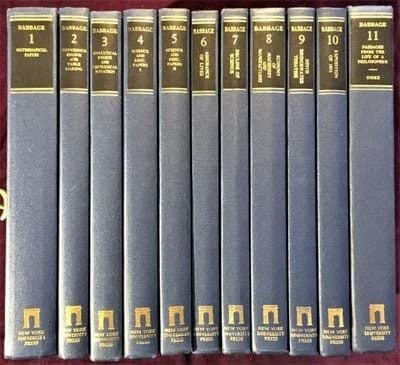
On the Economy of Machinery and ManufacturesBabbage, Charles
ReligionComparative
On the Economy of Machinery and Manufactures
Babbage, Charles
Machinery; Manufactures
"When employers are competent to show their men that their
business is steady and certain, and when men find that they are
likely to have permanent employment, they have always better
habits, and more settled notions, which will make them better
men, and better workmen, and will produce great benefits to all
who are interested in their employment."
366. As the manufacturer, when he makes a contract, has no
security that a combination may not arise amongst the workmen,
which may render that contract a loss instead of a benefit;
besides taking precautions to prevent them from becoming
acquainted with it, he must also add to the price at which he
could otherwise sell the article, some small increase to cover
the risk of such an occurrence. If an establishment consist of
several branches which can only be carried on jointly, as, for
instance, of iron mines, blast furnaces, and a colliery, in which
there are distinct classes of workmen, it becomes necessary to
keep on hand a larger stock of materials than would be required,
if it were certain that no combinations would arise.
Suppose, for instance, the colliers were to 'strike' for an
advance of wages--unless there was a stock of coal above ground,
the furnaces must be stopped, and the miners also would be thrown
out of employ. Now the cost of keeping a stock of iron ore, or of
coals above ground, is just the same as that of keeping in a
drawer, unemployed, its value in money, (except, indeed, that the
coal suffers a small deterioration by exposure to the elements).
The interest of this sum must, therefore, be considered as the
price of an insurance against the risk of combination amongst the
workmen; and it must, so far as it goes, increase the price of
the manufactured article, and, consequently, limit the demand
which would otherwise exist for it. But every circumstance which
tends to limit the demand, is injurious to the workmen; because
the wider the demand, the less it is exposed to fluctuation.
The effect to which we have alluded, is by no means a
theoretical conclusion; the proprietors of one establishment in
the iron trade, within the author's knowledge, think it expedient
always to keep above ground a supply of coal for six months,
which is, in that instance, equal in value to about L10,000. When
we reflect that the quantity of capital throughout the country
thus kept unemployed merely from the fear of combinations amongst
the workmen, might, under other circumstances, be used for
keeping a larger number at work, the importance of introducing a
system in which there should exist no inducement to combine
becomes additionally evident.
Public-domain text, read in full here on John Shaqi.
Reviews
Reviews
No reviews yet
Be the first to share your thoughts on this work.
Elsewhere in the archive
Join the Discussion
Join the discussion
Sign in to leave a comment or review.
Sign InorCreate an account