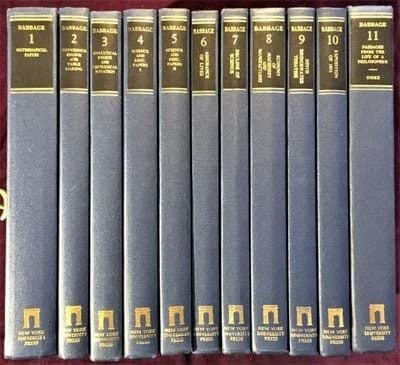
On the Economy of Machinery and ManufacturesBabbage, Charles
ReligionComparative
On the Economy of Machinery and Manufactures
Babbage, Charles
Machinery; Manufactures
368. Amongst the evils which ultimately fall heavy on the
working classes themselves, when, through mistaken views, they
attempt to interfere with their employers in the mode of carrying
on their business, may be mentioned the removal of factories to
other situations, where the proprietors may be free from the
improper control of their men. The removal of a considerable
number of lace frames to the western counties, which took place,
in consequence of the combinations in Nottinghamshire, has
already been mentioned. Other instances have occurred, where
still greater injury has been produced by the removal of a
portion of the skill and capital of the country to a foreign
land. Such was the case at Glasgow, as stated in the fifth
Parliamentary Report respecting Artizans and Machinery. One of
the partners in an extensive cotton factory, disgusted by the
unprincipled conduct of the workmen, removed to the state of New
York, where he re-established his machinery, and thus afforded,
to rivals already formidable to our trade, at once a pattern of
our best machinery, and an example of the most economical methods
of employing it.
369. When the nature of the work is such that it is not
possible to remove it, as happens with regard to mines, the
proprietors are more exposed to injury from combinations amongst
the workmen: but as the owners are generally possessed of a
larger capital, they generally succeed, if the reduction of wages
which they propose is really founded on the necessity of the
case.
An extensive combination lately existed amongst the colliers
in the north of England, which unfortunately led, in several
instances, to acts of violence. The proprietors of the coalmines
were consequently obliged to procure the aid of miners from other
parts of England who were willing to work at the wages they could
afford to give; and the aid of the civil, and in some cases of
the military, power, was requisite for their protection. This
course was persisted in during several months, and the question
being, which party could support itself longest on the diminished
gains, as it might have readily been foreseen, the proprietors
ultimately succeeded.
Public-domain text, read in full here on John Shaqi.
Reviews
Reviews
No reviews yet
Be the first to share your thoughts on this work.
Elsewhere in the archive
Join the Discussion
Join the discussion
Sign in to leave a comment or review.
Sign InorCreate an account