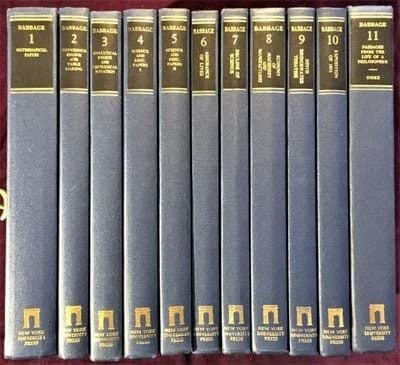
On the Economy of Machinery and ManufacturesBabbage, Charles
ReligionComparative
On the Economy of Machinery and Manufactures
Babbage, Charles
Machinery; Manufactures
377. There occurs another kind of combination against the
public, with which it is difficult to deal. It usually ends in a
monopoly, and the public are then left to the discretion of the
monopolists not to charge them above the growling point--that
is, not to make them pay so much as to induce them actually to
combine against the imposition. This occurs when two companies
supply water or gas to consumers by means of pipes laid down
under the pavement in the street of cities: it may possibly occur
also in docks, canals, railroads, etc., and in other cases where
the capital required is very large, and the competition very
limited. If water or gas companies combine, the public
immediately loses all the advantage of competition, and it has
generally happened, that at the end of a period during which they
have undersold each other, the several companies have agreed to
divide the whole district supplied, into two or more parts, each
company then removing its pipes from all the streets except those
in its own portion. This removal causes great injury to the
pavement, and when the pressure of increased rates induces a new
company to start, the same inconvenience is again produced.
Perhaps one remedy against evils of this kind might be, when a
charter is granted to such companies, to restrict, to a certain
amount, the rate of profit on the shares, and to direct that any
profits beyond, shall accumulate for the repayment of the
original capital. This has been done in several late Acts of
Parliament establishing companies. The maximum rate of profit
allowed ought to be liberal, to compensate for the risk; the
public ought to have auditors on their part, and the accounts
should be annually published, for the purpose of preventing the
limitations from being exceeded. It must however be admitted,
that this would be an interference with capital, which, if
allowed, should, in the present state of our knowledge, be.
examined with great circumspection in each individual case, until
some general principle is established on well-admitted grounds.
378. An instrument called a gas-meter, which ascertains the
quantity of gas used by each consumer, has been introduced, and
furnishes a satisfactory mode of determining the payments to be
made by individuals to the gas companies. A contrivance somewhat
similar in its nature, might be used for the sale of water; but
in that case some public inconvenience might be apprehended, from
the diminished quantity which would then run to waste: the
streams of water running through the sewers in London, are
largely supplied from this source; and if this supply were
diminished, the drainage of the metropolis might be injuriously
affected.
Public-domain text, read in full here on John Shaqi.
Reviews
Reviews
No reviews yet
Be the first to share your thoughts on this work.
Elsewhere in the archive
Join the Discussion
Join the discussion
Sign in to leave a comment or review.
Sign InorCreate an account