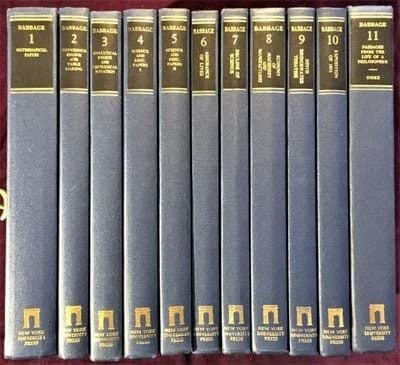
On the Economy of Machinery and ManufacturesBabbage, Charles
ReligionComparative
On the Economy of Machinery and Manufactures
Babbage, Charles
Machinery; Manufactures
It has been so common in our town to pay goods instead of
money, that a number of my neighbours have been obliged to pay
articles for articles, to pay sugar for drugs out of the
druggist's shop; and others have been obliged to pay sugar for
drapery goods, and such things, and exchange in that way numbers
of times. I was credibly informed, that one person paid half a
pound of tenpenny sugar and a penny to have a tooth drawn; and
there is a credible neighbour of mine told me, that he had heard
that the sexton had been paid for digging a grave with sugar and
tea: and before I came off, knowing I had to give evidence upon
these things, I asked this friend to enquire of the sexton,
whether this was a fact: the sexton hesitated for a little time,
on account of bringing into discredit the person who paid these
goods: however, he said at last, 'I have received these articles
repeatedly--I know these things have been paid to a great extent
in this way.'
NOTES:
1. See Chapter XV, p. 87
Chapter 31
On Combinations of Masters against the public
376. A species of combination occasionally takes place
amongst manufacturers against persons having patents: and these
combinations are always injurious to the public, as well as
unjust to the inventors. Some years since, a gentleman invented a
machine, by which modellings and carvings were cut in mahogany,
and other fine woods. The machine resembled, in some measure, the
drilling apparatus employed in ornamental lathes; it produced
beautiful work at a very moderate expense: but the cabinetmakers
met together, and combined against it, and the patent has
consequently never been worked. A similar fate awaited a machine
for cutting veneers by means of a species of knife. In this
instance, the wood could be cut thinner than by the circular saw,
and no waste was incurred; but 'the trade' set themselves against
it, and after a heavy expense, it was given up.
The excuse alleged for this kind of combination, was the fear
entertained by the cabinetmakers that when the public became
acquainted with the article, the patentee would raise the price.
Similar examples of combination seem not to be unfrequent, as
appears by the Report of the Committee of the House of Commons on
Patents for Inventions, June, 1829. See the evidence of Mr
Holdsworth.
Public-domain text, read in full here on John Shaqi.
Reviews
Reviews
No reviews yet
Be the first to share your thoughts on this work.
Elsewhere in the archive
Join the Discussion
Join the discussion
Sign in to leave a comment or review.
Sign InorCreate an account