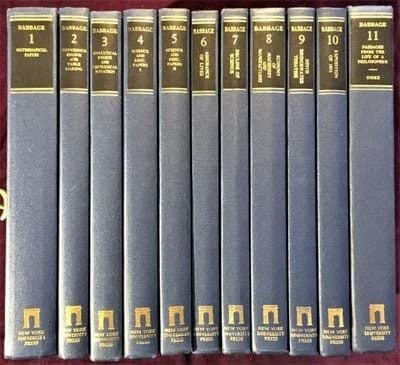
On the Economy of Machinery and ManufacturesBabbage, Charles
ReligionComparative
On the Economy of Machinery and Manufactures
Babbage, Charles
Machinery; Manufactures
385. There appears to be little reason for this distinction
in charging for printing a larger price to the author than to the
publisher, provided the former is able to give equal security for
the payment. With respect to the additional charge on paper, if
the author employs either publisher or printer to purchase it,
they ought to receive a moderate remuneration for the risk, since
they become responsible for the payment; but there is no reason
why, if the author deals at once with the paper-maker, he should
not purchase on the same terms as the printer; and if he choose,
by paying ready money, not to avail himself of the long credit
allowed in those trades, he ought to procure his paper
considerably cheaper.
386. It is time, however, that such conventional combinations
between different trades should be done away with. In a country
so eminently depending for its wealth on its manufacturing
industry, it is of importance that there should exist no abrupt
distinction of classes, and that the highest of the aristocracy
should feel proud of being connected, either personally or
through their relatives, with those pursuits on which their
country's greatness depends. The wealthier manufacturers and
merchants already mix with those classes, and the larger and even
the middling tradesmen are frequently found associating with the
gentry of the land. It is good that this ambition should be
cultivated, not by any rivalry in expense, but by a rivalry in
knowledge and in liberal feelings; and few things would more
contribute to so desirable an effect, than the abolition of all
such contracted views as those to which we have alluded. The
advantage to the other classes, would be an increased
acquaintance with the productive arts of the country an increased
attention to the importance of acquiring habits of punctuality
and of business and, above all, a general feeling that it is
honourable, in any rank of life, to increase our own and our
country's riches, by employing our talents in the production or
in the distribution of wealth.
387. Another circumstance omitted to be noticed in the first
edition relates to what is technically called the overplus, which
may be now explained. When 500 copies of a work are to be
printed, each sheet of it requires one ream of paper. Now a ream,
as used by printers, consists of 21 1/2 quires, or 516 sheets.
This excess of sixteen sheets is necessary in order to allow for
'revises'--for preparing and adjusting the press for the due
performance of its work, and to supply the place of any sheets
which may be accidentally dirtied or destroyed in the processes
of printing, or injured by the binder in putting into boards. It
is found, however, that three per cent is more than the
proportion destroyed, and that damage is less frequent in
proportion to the skill and care of the workmen.
Public-domain text, read in full here on John Shaqi.
Reviews
Reviews
No reviews yet
Be the first to share your thoughts on this work.
Elsewhere in the archive
Join the Discussion
Join the discussion
Sign in to leave a comment or review.
Sign InorCreate an account