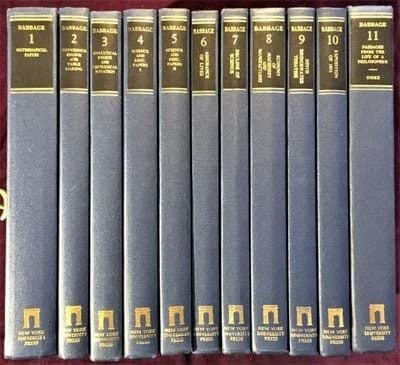
On the Economy of Machinery and ManufacturesBabbage, Charles
ReligionComparative
On the Economy of Machinery and Manufactures
Babbage, Charles
Machinery; Manufactures
From the evidence of several highly respectable booksellers
and printers, before the Committee of the House of Commons on the
Copyright Act, May, 1818, it appears that the average number of
surplus copies, above 500, is between two and three; that on
smaller impressions it is less, whilst on larger editions it is
greater; that, in some instances, the complete number of 500 is
not made up, in which case the printer is obliged to pay for
completing it; and that in no instance have the whole sixteen
extra copies been completed. On the volume in the reader's hands,
the edition of which consisted of 3000, the surplus amounted to
fifty-two--a circumstance arising from the improvements in
printing and the increased care of the pressmen. Now this
overplus ought to be accounted for to the author--and I believe
it usually is so by all respectable publishers.
388. In order to prevent the printer from privately taking
off a larger number of impressions than he delivers to the author
or publisher, various expedients have been adopted. In some works
a particular watermark has been used in paper made purposely for
the book: thus the words 'Mecanique Celeste' appear in the
watermark of the two first volumes of the great work of Laplace.
In other cases, where the work is illustrated by engravings, such
a fraud would be useless without the concurrence of the
copperplate printer. In France it is usual to print a notice on
the back of the title page, that no copies are genuine without
the subjoined signature of the author: and attached to this
notice is the author's name, either written, or printed by hand
from a wooden block. But notwithstanding this precaution, I have
recently purchased a volume, printed at Paris, in which the
notice exists, but no signature is attached. In London there is
not much danger of such frauds, because the printers are men of
capital, to whom the profit on such a transaction would be
trifling, and the risk of the detection of a fact, which must of
necessity be known to many of their workmen, would be so great as
to render the attempt at it folly.
389. Perhaps the best advice to an author, if he publishes on
his own account, and is a reasonable person, possessed of common
sense, would be to go at once to a respectable printer and make
his arrangements with him.
390. If the author do not wish to print his work at his own
risk, then he should make an agreement with a publisher for an
edition of a limited number; but he should by no means sell the
copyright. If the work contains woodcuts or engravings, it would
be judicious to make it part of the contract that they shall
become the author's property, with the view to their use in a
subsequent edition of the works, if they should be required. An
agreement is frequently made by which the publisher advances the
money and incurs all the risk on condition of his sharing the
profits with the author. The profits alluded to are, for the
present work, the last item of section 382, or L306 4s.
Public-domain text, read in full here on John Shaqi.
Reviews
Reviews
No reviews yet
Be the first to share your thoughts on this work.
Elsewhere in the archive
Join the Discussion
Join the discussion
Sign in to leave a comment or review.
Sign InorCreate an account