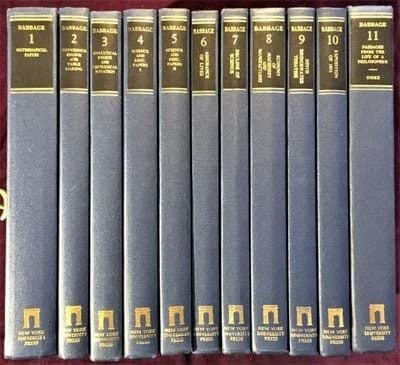
On the Economy of Machinery and ManufacturesBabbage, Charles
ReligionComparative
On the Economy of Machinery and Manufactures
Babbage, Charles
Machinery; Manufactures
Some of the writers, who have published criticisms on the
observations made in the first edition of this work, have
admitted that the apparent rate of profit to the booksellers is
too large. But they have, on the other hand, urged that too
favourable a case is taken in supposing the whole 3000 copies
sold. If the reader will turn back to section 382, he will find
that the expense of the three first items remains the same,
whatever be the number of copies sold; and on looking over the
remaining items he will perceive that the bookseller, who incurs
very little risk and no outlay, derives exactly the same profit
per cent on the copies sold, whatever their numbers may be. This,
however, is not the case with the unfortunate author, on whom
nearly the whole of the loss falls undivided. The same writers
have also maintained, that the profit is fixed at the rate
mentioned, in order to enable the bookseller to sustain losses,
unavoidably incurred in the purchase and retail of other books.
This is the weakest of all arguments. It would be equally just
that a merchant should charge an extravagant commission for an
undertaking unaccompanied with any risk, in order to repay
himself for the losses which his own want of skill might lead to
in his other mercantile transactions.
395. That the profit in retailing books is really too large,
is proved by several circumstances: First, that the same nominal
rate of profit has existed in the bookselling trade for a long
series of years, notwithstanding the great fluctuations in the
rate of profit on capital invested in every other business.
Secondly, that, until very lately, a multitude of booksellers, in
all parts of London, were content with a much smaller profit, and
were willing to sell for ready money, or at short credit, to
persons of undoubted character, at a profit of only ten per cent,
and in some instances even at a still smaller percentage, instead
of that of twenty-five per cent on the published prices. Thirdly,
that they are unable to maintain this rate of profit except by a
combination, the object of which is to put down all competition.
396. Some time ago a small number of the large London
booksellers entered into such a combination. One of their objects
was to prevent any bookseller from selling books for less than
ten per cent under the published prices; and in order to enforce
this principle, they refuse to sell books, except at the
publishing price, to any bookseller who declines signing an
agreement to that effect. By degrees, many were prevailed upon to
join this combination; and the effect of the exclusion it
inflicted, left the small capitalist no option between signing or
having his business destroyed. Ultimately, nearly the whole
trade, comprising about two thousand four hundred persons, have
been compelled to sign the agreement.
Public-domain text, read in full here on John Shaqi.
Reviews
Reviews
No reviews yet
Be the first to share your thoughts on this work.
Elsewhere in the archive
Join the Discussion
Join the discussion
Sign in to leave a comment or review.
Sign InorCreate an account