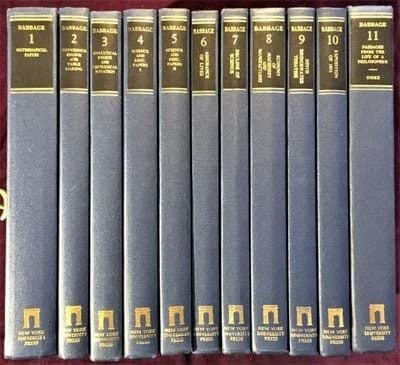
On the Economy of Machinery and Manufactures — John Shaqi
On the Economy of Machinery and ManufacturesBabbage, Charles
ReligionComparative
On the Economy of Machinery and Manufactures
Babbage, Charles
Machinery; Manufactures
25. ii) The boiler of a steam-engine sometimes bursts even
during the escape of steam through the safety-valve. If the water
in the boiler is thrown upon any part which happens to be red
hot, the steam formed in the immediate neighbourhood of that part
expands with greater velocity than that with which a wave can be
transmitted through the less heated steam; consequently one
particle is urged against the next, and an almost invincible
obstacle is formed, in the same manner as described in the case
of the discharge of a gun. If the safety-valve is closed, it may
retain the pressure thus created for a short time, and even when
it is open the escape may not be sufficiently rapid to remove all
impediment; there may therefore exist momentarily within the
boiler pressures of various force, varying from that which can
just lift the safety-valve up to that which is sufficient, if
exerted during an extremely small space of time, to tear open the
boiler itself.
26. This reasoning ought, however, to be admitted with
caution; and perhaps some inducement to examine it carefully may
be presented by tracing it to extreme cases. It would seem, but
this is not a necessary consequence, that a gun might be made so
long, that it would burst although no obstacle filled up its
muzzle. It should also follow that if, after the gun is charged,
the air were extracted from the barrel, though the muzzle be then
left closed, the gun ought not to burst. It would also seem to
follow from the principle of the explanation, that a body might
be projected in air, or other elastic resisting medium, with such
force that, after advancing a very short space it should return
in the same direction in which it was projected.
NOTES:
1. See Poisson's remarks, Ecole Polytec. Cahier, xxi, p. 191.
Chapter 3
Regulating Power
27. Uniformity and steadiness in the rate at which machinery
works, are essential both for its effect and its duration. The
first illustration which presents itself is that beautiful
contrivance, the governor of the steam-engine, which must
immediately occur to all who are familiar with that admirable
engine. Wherever the increased speed of the engine would lead to
injurious or dangerous consequences, this is applied; and it is
equally the regulator of the water-wheel which drives a
spinning-jenny, or of the windmills which drain our fens. In the
dockyard at Chatham, the descending motion of a large platform,
on which timber is raised, is regulated by a governor; but as the
weight is very considerable, the velocity of this governor is
still further checked by causing its motion to take place in
water.
28. Another very beautiful contrivance for regulating the
number of strokes made by a steam-engine, is used in Cornwall: it
is called the cataract, and depends on the time required to fill
a vessel plunged in water, the opening of the valve through which
the fluid is admitted being adjustable at the will of the
engine-man.
Public-domain text, read in full here on John Shaqi.
Reviews
Reviews
No reviews yet
Be the first to share your thoughts on this work.
Join the Discussion
Join the discussion
Sign in to leave a comment or review.
Sign InorCreate an account