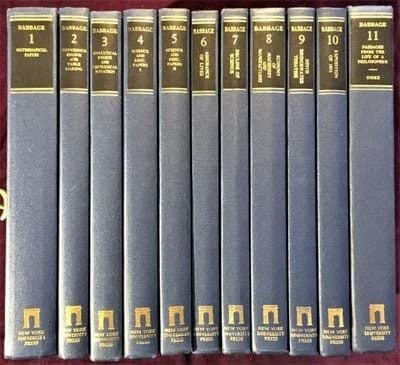
On the Economy of Machinery and ManufacturesBabbage, Charles
ReligionComparative
On the Economy of Machinery and Manufactures
Babbage, Charles
Machinery; Manufactures
420. The process employed in manufacturing often depends upon
the mode in which a tax is levied on the materials, or on the
article produced. W atch glasses are made in England by workmen
who purchase from the glass house globes of five or six inches in
diameter, out of which, by means of a piece of red-hot tobacco
pipe, guided round a pattern watch glass placed on the globe,
they crack five others: these are afterwards ground and smoothed
on the edges. In the Tyrol the rough watch glasses are supplied
at once from the glass house; the workman, applying a thick ring
of cold glass to each globe as soon as it is blown, causes a
piece, of the size of a watch glass, to be cracked out. The
remaining portion of the globe is immediately broken, and returns
to the melting pot. This process could not be adopted in England
with the same economy, because the whole of the glass taken out
of the pot is subject to the excise duty.
421. The objections thus stated as incidental to particular
modes of taxation are not raised with a view to the removal of
those particular taxes; their fitness or unfitness must be
decided by a much wider enquiry, into which it is not the object
of this volume to enter. Taxes are essential for the security
both of liberty and property, and the evils which have been
mentioned may be the least amongst those which might have been
chosen. It is, however, important that the various effects of
every tax should be studied, and that those should be adopted
which, upon the whole, are found to give the least check to the
productive industry of the country.
422. In enquiring into the effect produced, or to be
apprehended from any particular mode of taxation, it is necessary
to examine a little into the interests of the parties who approve
of the plan in question, as well as of those who object to it.
Instances have occurred where the persons paying a tax into the
hands of government have themselves been adverse to any
reduction. This happened in the case of one class of
calico-printers, whose interest really was injured by a removal
of the tax on the printing: they received from the manufacturers,
payment for the duty, about two months before they were
themselves called on to pay it to government; and the consequence
was, that a considerable capital always remained in their hands.
The evidence which states this circumstance is well calculated to
promote a reasonable circumspection in such enquiries.
Question. Do you happen to know anything of an opposition
from calico printers to the repeal of the tax on printed calicoes?
Public-domain text, read in full here on John Shaqi.
Reviews
Reviews
No reviews yet
Be the first to share your thoughts on this work.
Elsewhere in the archive
Join the Discussion
Join the discussion
Sign in to leave a comment or review.
Sign InorCreate an account