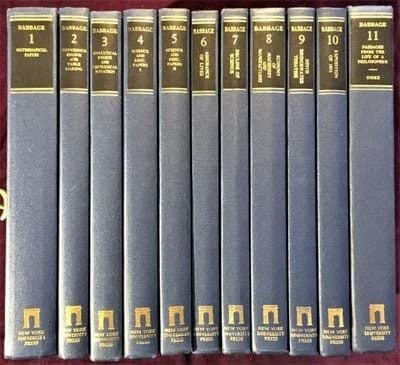
On the Economy of Machinery and ManufacturesBabbage, Charles
ReligionComparative
On the Economy of Machinery and Manufactures
Babbage, Charles
Machinery; Manufactures
Answer. I have certainly heard of such an opposition, and am
not surprised at it. There are very few individuals who are, in
fact, interested in the nonrepeal of the tax; there are two
classes of calico-printers; one, who print their own cloth, send
their goods into the market, and sell them on their own account;
they frequently advance the duty to government, and pay it in
cash before their goods are sold, but generally before the goods
are paid for, being most commonly sold on a credit of six months:
they are of course interested on that account, as well as on
others that have been stated, in the repeal of the tax. The other
class of calico-printers print the cloth of other people; they
print for hire, and on re-delivery of the cloth when printed,
they receive the amount of the duty, which they are not called
upon to pay to government sooner, on an average, than nine weeks
from the stamping of the goods. Where the business is carried on
upon a large scale, the arrears of duty due to government often
amount to eight, or even ten thousand pounds, and furnish a
capital with which these gentlemen carry on their business; it is
not, therefore, to be wondered at that they should be opposed to
the prayer of our petition.
423. The policy of giving bounties upon home productions, and
of enforcing restrictions against those which can be produced
more cheaply in other countries, is of a very questionable
nature: and, except for the purpose of introducing a new
manufacture, in a country where there is not much commercial or
manufacturing spirit, is scarcely to be defended. All incidental
modes of taxing one class of the community, the consumers, to an
unknown extent, for the sake of supporting another class, the
manufacturers, who would otherwise abandon that mode of employing
their capital, are highly objectionable. One part of the price of
any article produced under such circumstances, consists of the
expenditure, together with the ordinary profits of capital: the
other part of its price may be looked upon as charity, given to
induce the manufacturer to continue an unprofitable use of his
capital, in order to give employment to his workmen. If the sum
of what the consumers are thus forced to pay, merely on account
of these artificial restrictions, where generally known, its
amount would astonish even those who advocate them; and it would
be evident to both parties, that the employment of capital in
those branches of trade ought to be abandoned.
Public-domain text, read in full here on John Shaqi.
Reviews
Reviews
No reviews yet
Be the first to share your thoughts on this work.
Elsewhere in the archive
Join the Discussion
Join the discussion
Sign in to leave a comment or review.
Sign InorCreate an account