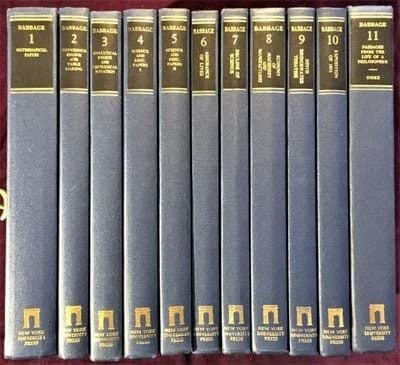
On the Economy of Machinery and ManufacturesBabbage, Charles
ReligionComparative
On the Economy of Machinery and Manufactures
Babbage, Charles
Machinery; Manufactures
The many important facilities for the construction of
machines and the manufacturing of commodities which we possess,
are enjoyed by no other country; nor is it likely that any
country can enjoy them to an equal extent for an indefinite
period. It is admitted by everyone, that our skill is unrivalled;
the industry and power of our people unequalled; their
ingenuity, as displayed in the continuol improvement in
machinery, and production of commodities, without parallel; and
apparently, without limit. The freedom which, under our
government, every man has, to use his capital, his labour, and
his talents, in the manner most conducive to his interests, is an
inestimable advantage; canals are cut, and railroads constructed,
by the voluntary association of persons whose local knowledge
enables them to place them in the most desirable situations; and
these great advantages cannot exist under less free governments.
These circumstances, when taken together, give such a decided
superiority to our people, that no injurious rivalry, either in
the construction of machinery or the manufacture of commodities,
can reasonably be anticipated.
442. But, even if it were desirable to prevent the
exportation of a certain class of machinery, it is abdundantly
evident, that, whilst the exportation of other classes is
allowed, it is impossible to prevent the forbidden one from being
smuggled out; and that, in point of fact, the additional risk has
been well calculated by the smuggler.
443. It would appear, also, from various circumstances, that
the immediate exportation of improved machinery is not quite so
certain as has been assumed; and that the powerful principle of
self-interest will urge the makers of it, rather to push the sale
in a different direction. When a great maker of machinery has
contrived a new machine for any particular process, or has made
some great improvement upon those in common use, to whom will he
naturally apply for the purpose of selling his new machines?
Undoubtedly, in by far the majority of cases, to his nearest and
best customers, those to whom he has immediate and personal
access, and whose capability to fulfil any contract is best known
to him. With these, he will communicate and offer to take their
orders for the new machine; nor will he think of writing to
foreign customers, so long as he finds the home demand sufficient
to employ the whole force of his establishment. Thus, therefore,
the machine-maker is himself interested in giving the first
advantage of any new improvement to his own countrymen.
Public-domain text, read in full here on John Shaqi.
Reviews
Reviews
No reviews yet
Be the first to share your thoughts on this work.
Elsewhere in the archive
Join the Discussion
Join the discussion
Sign in to leave a comment or review.
Sign InorCreate an account