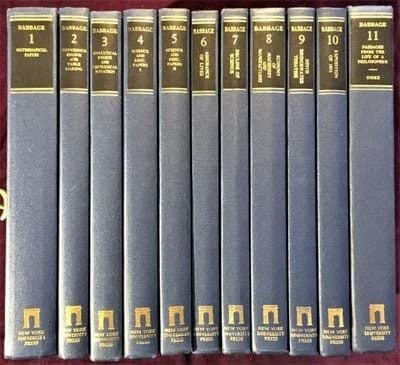
On the Economy of Machinery and ManufacturesBabbage, Charles
ReligionComparative
On the Economy of Machinery and Manufactures
Babbage, Charles
Machinery; Manufactures
465. But perhaps a doubt may arise in the mind, whilst
contemplating the continually increasing field of human
knowledge, that the weak arm of man may want the physical force
required to render that knowledge available. The experience of
the past, has stamped with the indelible character of truth, the
maxim, that knowledge is power. It not merely gives to its
votaries control over the mental faculties of their species, but
is itself the generator of physical force. The discovery of the
expansive power of steam, its condensation, and the doctrine of
latent heat, has already added to the population of this small
island, millions of hands. But the source of this power is not
without limit, and the coal-mines of the world may ultimately be
exhausted. Without adverting to the theory, that new deposits of
that mineral are not accumulating under the sea, at the estuaries
of some of our larger rivers; without anticipating the
application of other fluids requiring a less supply of caloric
than water--we may remark that the sea itself offers a perennial
source of power hitherto almost unapplied. The tides, twice in
each day, raise a vast mass of water, which might be made
available for driving machinery. But supposing heat still to
remain necessary, when the exhausted state of our coal fields
renders it expensive: long before that period arrives, other
methods will probably have been invented for producing it. In
some districts, there are springs of hot water, which have flowed
for centuries unchanged in temperature. In many parts of the
island of Ischia, by deepening the sources of the hot springs
only a few feet, the water boils; and there can be little doubt
that, by boring a short distance, steam of high pressure would
issue from the orifice.(5*)
In Iceland, the sources of heat are still more plentiful; and
their proximity to large masses of ice, seems almost to point out
the future destiny of that island. The ice of its glaciers may
enable its inhabitants to liquefy the gases with the least
expenditure of mechanical force; and the heat of its volcanoes
may supply the power necessary for their condensation. Thus, in a
future age, power may become the staple commodity of the
Icelanders, and of the inhabitants of other volcanic
districts;(6*) and possibly the very process by which they will
procure this article of exchange for the luxuries of happier
climates may, in some measure, tame the tremendous element which
occasionally devastates their provinces.
466. Perhaps to the sober eye of inductive philosophy, these
anticipations of the future may appear too faintly connected with
the history of the past. When time shall have revealed the future
progress of our race, those laws which are now obscurely
indicated, will then become distinctly apparent; and it may
possibly be found that the dominion of mind over the material
world advances with an everaccelerating force.
Public-domain text, read in full here on John Shaqi.
Reviews
Reviews
No reviews yet
Be the first to share your thoughts on this work.
Elsewhere in the archive
Join the Discussion
Join the discussion
Sign in to leave a comment or review.
Sign InorCreate an account