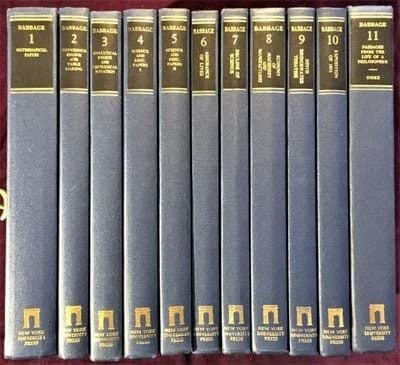
On the Economy of Machinery and ManufacturesBabbage, Charles
ReligionComparative
On the Economy of Machinery and Manufactures
Babbage, Charles
Machinery; Manufactures
But however large the interval that separates the lowest from
the highest of those sentient beings which inhabit our planet,
all the results of observation, enlightened by all the reasonings
of the philosopher, combine to render it probable that, in the
vast extent of creation, the proudest attribute of our race is
but, perchance, the lowest step in the gradation of intellectual
existence. For, since every portion of our own material globe,
and every animated being it supports, afford, on more
scrutinizing enquiry, more perfect evidence of design, it would
indeed be most unphilosophical to believe that those sister
spheres, obedient to the same law, and glowing with light and
heat radiant from the same central source--and that the members
of those kindred systems, almost lost in the remoteness of space,
and perceptible only from the countless multitude of their
congregated globes should each be no more than a floating chaos
of unformed matter; or, being all the work of the same Almighty
Architect, that no living eye should be gladdened by their forms
of beauty, that no intellectual being should expand its faculties
in decyphering their laws.
NOTES:
1. Reflections on the Decline of Science in England, and on some
of its Causes. 8vo. 1830. Fellowes.
2. The Duke of Sussex was proposed as President of the Royal
Society in opposition to the wish of the Council in opposition to
the public declaration of a body of Fellows, comprising the
largest portion of those by whose labours the character of
English science had been maintained The aristocracy of rank and
of power, aided by such allies as it can always command, set
itself in array against the prouder aristocracy of science. Out
of about seven hundred members, only two hundred and thirty
balloted; and the Duke of Sussex had a majority of eight. Under
such circumstances, it was indeed extraordinary, that His Royal
Highness should have condescended to accept the fruits of that
doubtful and inauspicious victory.
The circumstances preceding and attending this singular
contest have been most ably detailed in a pamphlet entitled A
Statement of the Circumstances connected with the late Election
for the, Presidency of the Royal Society, 1831, printed by R.
Taylor, Red Lion Court, Fleet Street. The whole tone of the tract
is strikingly contrasted with that of the productions of some of
those persons by whom it was His Royal Highness's misfortune to
be supported.
3. The second meeting took place at Oxford in June 1832, and
surpassed even the sanguine anticipations of its friends. The
third annual meeting will take place at Cambridge in June 1833.
Public-domain text, read in full here on John Shaqi.
Reviews
Reviews
No reviews yet
Be the first to share your thoughts on this work.
Elsewhere in the archive
Join the Discussion
Join the discussion
Sign in to leave a comment or review.
Sign InorCreate an account