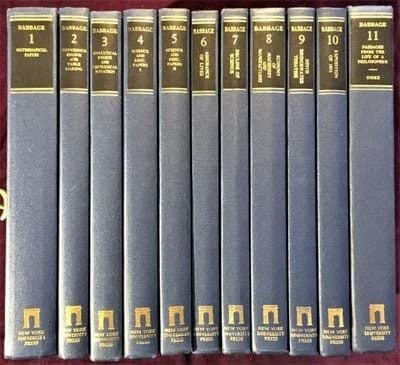
On the Economy of Machinery and ManufacturesBabbage, Charles
ReligionComparative
On the Economy of Machinery and Manufactures
Babbage, Charles
Machinery; Manufactures
Question. At the time you performed that voyage, with the weather
you have described, from the Downs to Milford, if that weather
had continued twelve months, would any square-rigged vessel have
performed it?
Answer. They would have been a long time about it: probably,
would have been weeks instead of days. A sailing vessel would not
have beat up to Milford, as we did, in twelve months.
61. The process of printing on the silver paper, which is
necessary for bank-notes, is attended with some inconvenience,
from the necessity of damping the paper previously to taking the
impression. It was difficult to do this uniformly and in the old
process of dipping a parcel of several sheets together into a
vessel of water, the outside sheets becoming much more wet than
the others, were very apt to be torn. A method has been adopted
at the Bank of Ireland which obviates this inconvenience. The
whole quantity of paper to be damped is placed in a close vessel
from which the air is exhausted; water is then admitted, and
every leaf is completely wetted; the paper is then removed to a
press, and all the superfluous moisture is squeezed out.
62. The operation of pulverizing solid substances and of
separating the powders of various degrees of fineness, is common
in the arts: and as the best graduated sifting fails in effecting
this separation with sufficient delicacy, recourse is had to
suspension in a fluid medium. The substance when reduced by
grinding to the finest powder is agitated in water which is then
drawn off: the coarsest portion of the suspended matter first
subsides, and that which requires the longest time to fall down
is the finest. In this manner even emery powder, a substance of
great density, is separated into the various degrees of fineness
which are required. Flints, after being burned and ground, are
suspended in water, in order to mix them intimately with clay,
which is also suspended in the same fluid for the formation of
porcelain. The water is then in part evaporated by heat, and the
plastic compound, out of which our most beautiful porcelain is
formed, remains. It is a curious fact, and one which requires
further examination than it has yet received, that, if this
mixture be suffered to remain long at rest before it is worked
up, it becomes useless; for it is then found that the silex,
which at first was uniformly mixed, becomes aggregated together
in small lumps. This parallel to the formation of flints in the
chalk strata deserves attention.(2*)
Public-domain text, read in full here on John Shaqi.
Reviews
Reviews
No reviews yet
Be the first to share your thoughts on this work.
Join the Discussion
Join the discussion
Sign in to leave a comment or review.
Sign InorCreate an account