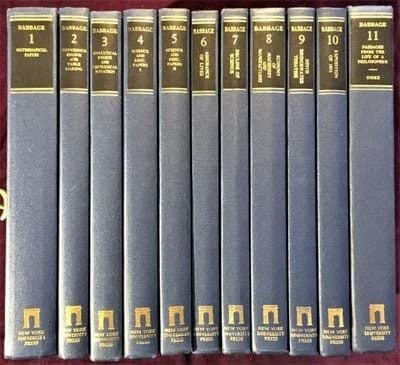
On the Economy of Machinery and ManufacturesBabbage, Charles
ReligionComparative
On the Economy of Machinery and Manufactures
Babbage, Charles
Machinery; Manufactures
1. Transactions of the Society of Arts, 1819, p. 116.
2. The contrivance is due to Mr Hencky, of High Holborn, in whose
establishment it is in constant use.
3. About seven or eight years since, without being aware of Sir
David Brewster's proposal. I adapted a barometer, as a pendulum,
to the works of a common eight day clock: it remained in my
library for several months, but I have mislaid the observations
which were made.
4. Memoires de l'Academie des Sciences de Petersburgh, 6e serie,
tom. i. p. 4.
Chapter 9
Economy of the Materials Employed
77. The precision with which all operations by machinery are
executed, and the exact similarity of the articles thus made,
produce a degree of economy in the consumption of the raw
material which is, in some cases, of great importance. The
earliest mode of cutting the trunk of a tree into planks, was by
the use of the hatchet or the adze. It might, perhaps, be first
split into three or four portions, and then each portion was
reduced to a uniform surface by those instruments. With such
means the quantity of plank produced would probably not equal the
quantity of the raw material wasted by the process: and, if the
planks were thin, would certainly fall far short of it. An
improved tool, completely reverses the case: in converting a tree
into thick planks, the saw causes a waste of a very small
fractional part; and even in reducing it to planks of only an
inch in thickness, does not waste more than an eighth part of the
raw material. When the thickness of the plank is still further
reduced, as is the case in cutting wood for veneering, the
quantity of material destroyed again begins to bear a
considerable proportion to that which is used; and hence circular
saws, having a very thin blade, have been employed for such
purposes. In order to economize still further the more valuable
woods, Mr Brunel contrived a machine which, by a system of
blades, cut off the veneer in a continuous shaving, thus
rendering the whole of the piece of timber available.
Public-domain text, read in full here on John Shaqi.
Reviews
Reviews
No reviews yet
Be the first to share your thoughts on this work.
Join the Discussion
Join the discussion
Sign in to leave a comment or review.
Sign InorCreate an account